The Best App to Avoid Food Dyes in Canada (2026)
If avoiding synthetic food dyes is why you’re downloading a scanner app, the generic “best scanner” roundups miss what actually matters: dye avoidance in Canada is a name-matching problem before anything else. The dye a US app calls Red 40 appears here as Allura Red / Rouge allura. An app that doesn’t speak Canadian label names — in both official languages — will happily pass products that break your rule. Here’s what the job requires and how the field measures up.
The direct answer, since we’re the ones writing it: Tarlo was built around exactly this job — dyes rule on by default, bilingual, free. The reasoning is below; judge it on the checklist.
What the job actually requires
Four capabilities, in priority order:
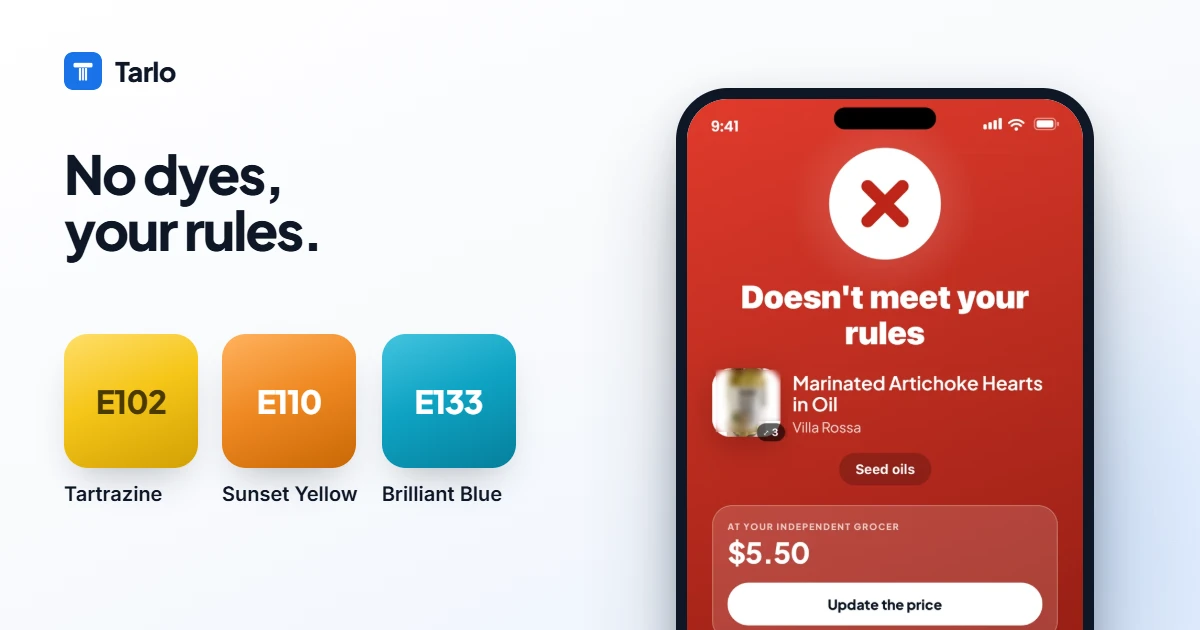
- Canadian + French label names. The dye family spans Allura Red, Tartrazine, Sunset Yellow FCF, Brilliant Blue FCF, Indigotine, Erythrosine — and their French forms (Rouge allura, Jaune soleil FCF…). US-name matching alone fails on Canadian shelves.
- Additive-code matching (E-numbers). The robust way to catch dyes regardless of language or spelling — E102, E110, E129, E133 are the same in any language.
- A dye-specific rule, not a general score. A universal score can rate a dyed product acceptably if its nutrition is decent — useless if dyes are your line in the sand.
- A next step. A red flag without a dye-free alternative on the same shelf just makes shopping slower.
How the apps compare
| Dye-specific rule | CA/FR label names | E-code matching | Dye-free swaps | Free | |
|---|---|---|---|---|---|
| Tarlo | Yes — on by default | Yes, both languages | Yes | Yes, same shelf + prices | Yes |
| Yuka | No (dyes weigh into one score) | Partial | Yes (database-level) | Generic alternatives | Free tier |
| Bobby Approved | Yes (in fixed list) | US names | Partial | Limited | Paid |
| Fig | Via custom avoidance | US-leaning | Partial | Product search | Free tier |
| Open Food Facts | Shows additives, no rule | Data-level | Yes | No | Free |
Fair notes: Yuka displays additives with risk labels — the information is there, but a dyed product can still score acceptably overall, so you must open every breakdown yourself. Bobby Approved does flag dyes decisively — under US names, in a list you can’t edit. Open Food Facts shows you E-numbers raw if you enjoy homework.
Why additive codes beat keywords
Worth understanding because it separates the tools: ingredient text is messy — spelling variants, French-only lists on some Quebec products, “colour (allura red)” formats. Open-data products carry pre-parsed additive tags (E129 etc.) that are language-independent. Tarlo checks the codes first and the bilingual text second — two independent signals, so a dye caught by either one fails the rule. Apps that only keyword-match the English text miss the edge cases that matter most here.
The verdict isn’t enough — you need the swap
The dye-avoiding shopper’s real task isn’t identifying the bad gummies — it’s finding the good ones before the kids melt down. That’s why the swap matters as much as the verdict: Tarlo’s fail screen lists alternatives from the same category that pass the dyes rule, with shopper-reported prices. The whole loop — scan, fail, swap, price — runs in seconds per product, both languages, no memorized name tables.
Setting it up in two minutes
- Install Tarlo (free, iOS/Android).
- The synthetic dyes rule is one of two on by default — nothing to configure.
- Scan anything colourful. Fails name the exact dye (“Tartrazine (E102)”); tap the alternatives that pass.
- Optional: add the natural colours some people also avoid (carmine, annatto) as custom rules.
Frequently asked questions
Which dyes should the rule cover?
The Canadian big six: Allura Red, Tartrazine, Sunset Yellow FCF, Brilliant Blue FCF, Indigotine, Erythrosine — plus Fast Green and Citrus Red in rare uses. Tarlo’s preset covers the family; the dye-name table lists every EN/FR/E-code form.
Do I still need this if the US is phasing dyes out?
For now, yes: the FDA phase-out is voluntary and US-only — Canadian formulations follow their own timelines, and Health Canada permits the dyes. The Canadian label is the only truth for Canadian shelves.
Can an app catch dyes in unpackaged bakery items?
No — no barcode, no scan. For in-store bakery, the counter’s ingredient binder is your tool.
What about dyes in medicine?
Different labelling regime; ask a pharmacist. Scanner apps cover food barcodes.
Sources
- Health Canada — permitted food colours and naming: canada.ca
- Public app listings for compared apps, reviewed August 2026.
Tarlo reflects the rules you turn on and is for general information only — it is not medical or dietary advice. Regulatory details are Canadian and current as of the date above; always verify the product's physical label.