Tarlo vs Yuka: Which Works Better in Canada?
Yuka popularized food scanning — 50 million people have used it, and it’s still what most people mean by “that scanner app.” Tarlo is the newcomer built on a different philosophy and built specifically for Canada. This is the complete comparison: where each app genuinely wins, where the philosophies collide, and a concrete example of how the same product can get opposite answers from each.
We make Tarlo, so read this as our honest case, kept strictly to features and approach — no “healthier app” claims, because verdicts about food belong to you, not to us.
Both apps are free to try — Tarlo here, Yuka in the app stores — so nothing below stops you from testing them side by side on your next grocery run.
At a glance
| Tarlo | Yuka | |
|---|---|---|
| Verdict model | Rules you choose, checked per product | One universal 0–100 score |
| Score formula | None — pass/fail per your rules | Nutrition 60% · additives 30% · organic 10% |
| Built for | Canada (Canadian catalog, EN/FR labels) | Global |
| Health Canada FOP thresholds | Yes, computed per reference amount | No — own scale |
| After a fail | Swaps on the same shelf + prices | Generic alternatives |
| Shelf prices | Yes — reported by shoppers | No |
| Handles “no data” | Says “not enough data”, never guesses | Scores what it has |
| Cost | Free | Free + premium subscription |
| Maturity | New and growing | 50M+ users, years of history |
Where Yuka genuinely wins
Three things, and they’re not small: database depth accumulated over years and tens of millions of users; simplicity — one number, zero setup, instantly understood by anyone; and network effects — friends use it, media cite it, manufacturers reformulate because of it. Yuka moved the entire industry toward transparency, and if what you want is a quick universal read with a huge community behind it, it remains the obvious choice.
Difference 1: one score vs your rules
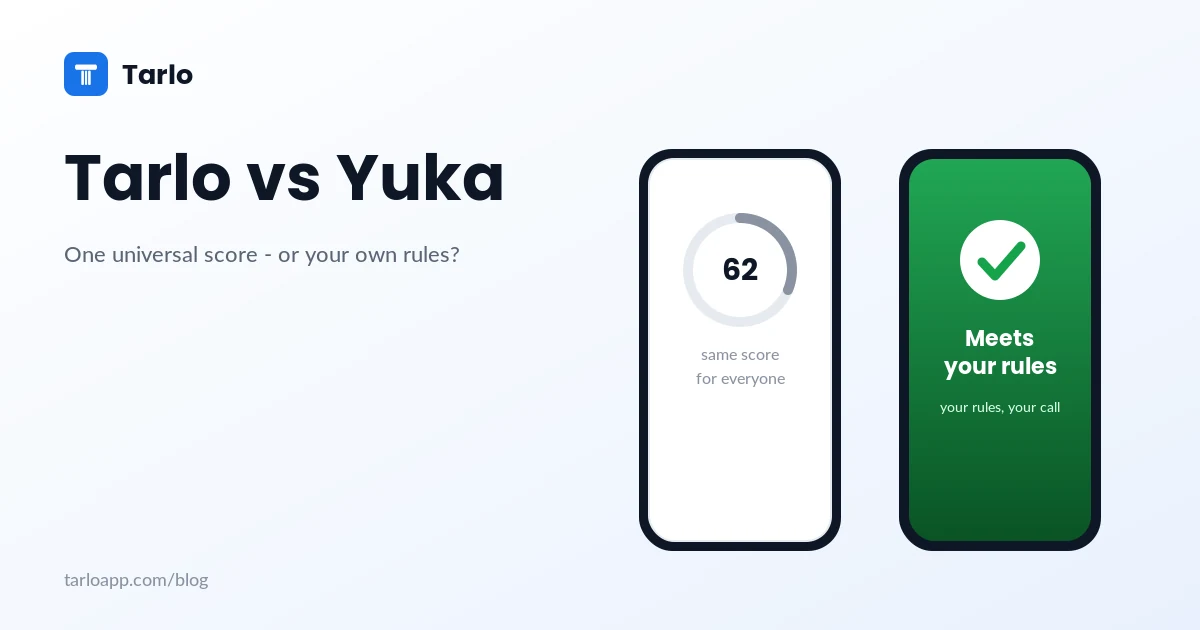
Yuka’s score bakes one set of priorities into a single number for everyone — 60% nutrition, 30% additives, 10% organic. That weighting is a choice someone made for you. If you don’t care about organic but care intensely about synthetic dyes, the score’s arithmetic doesn’t move the way your priorities do.
Tarlo has no score. You toggle rules — dyes, glucose-fructose, seed oils, artificial sweeteners, nitrites, BHA/BHT, high-in sodium, high-in sugars — and every scan answers one question: does this product meet the rules you set? Pass or fail, with the exact trigger named (“Allura Red (E129)”, “sodium 22% DV”). Two shoppers with different rules get different, both correct, answers. That’s the entire philosophical bet: personal rules beat universal averages.
Difference 2: built for Canada
Three Canada-specific things Tarlo does that a global score app structurally doesn’t:
- Canadian catalog first. Tarlo pre-loads the Canadian product slice, then fills the long tail live — aimed directly at the store-brand and regional products where global apps show gaps (more here).
- Health Canada’s actual thresholds. “High in sodium/sugars” verdicts are computed per Health Canada reference amount using the official front-of-package rules — the same standard now printed on packages — not a proprietary scale that can contradict the label.
- Bilingual matching. Canadian labels are English and French, and additive names differ between languages (“Allura Red” / “Rouge allura”). Tarlo’s matching covers both, plus the additive codes that don’t depend on language at all.
Difference 3: what happens after the verdict
This is the deepest product difference. Yuka’s interaction ends at the number: a 30/100 leaves you in the aisle with a red screen and a decision to make from scratch. Yuka does suggest alternatives, but they’re store-blind — generic products that may not exist in your store, at unknown prices.
Tarlo treats the verdict as the middle of the interaction: a fail comes with alternatives that pass your rules from the same shelf, each with a real shelf price reported by shoppers. “Doesn’t meet your rules → here’s one that does, two feet away, for $6.00” is a different product category than “this scored badly.” And prices are labelled as shopper-reported observations with a date — never presented as official.
Same product, opposite answers
A concrete, realistic example. Take a zero-sugar cola:
- Yuka: sugar-free helps the 60% nutrition weighting, but the artificial sweeteners hit the 30% additives weighting hard → typically a poor score. One number, same for everyone.
- Tarlo, shopper A (rules: high-in sugars only): no sugars → meets your rules.
- Tarlo, shopper B (rules: no artificial sweeteners): contains aspartame → doesn’t meet your rules, trigger named, dye-free-and-sweetener-free drink options offered from the same shelf.
Neither Tarlo answer contradicts the other — they answer different people. That’s the point. The Yuka score, meanwhile, answers an average person who isn’t quite either of them.
Who should use which
- Choose Yuka if: you want a single universal number, zero configuration, a massive community, and global coverage — and you don’t need Canadian thresholds or prices.
- Choose Tarlo if: you shop in Canada, your priorities are specific enough that someone else’s formula doesn’t fit, and you want the app to finish the job — swap plus price — when a product fails.
- Honestly fine: using both. Some shoppers keep Yuka for a general read and Tarlo for their hard rules and prices.
For the whole field, see best food scanner app in Canada — or the head-to-heads with Bobby Approved and Fig.
Frequently asked questions
Is Tarlo’s verdict “better” than Yuka’s score?
They’re different instruments. A score compresses everything into one general-purpose number; Tarlo checks your declared rules and shows its work. If your priorities match Yuka’s formula, the score serves you well; the further your priorities are from average, the more a rules model fits.
Does Yuka use Health Canada’s front-of-package thresholds?
No — Yuka’s nutrition scoring uses its own methodology. Tarlo computes high-in verdicts with Health Canada’s thresholds per reference amount, so its sodium/sugar verdicts align with the symbol system now on Canadian packages.
Where do Tarlo’s prices come from?
From shoppers — quick anonymous price reports tied to a store, shown with freshness context. They’re clearly labelled estimates/observations, never guaranteed prices. Details in how Tarlo works.
Is Tarlo free?
Yes — free on iOS and Android.
Sources
- Yuka — public methodology and feature pages, reviewed July–August 2026.
- Health Canada — front-of-package nutrition labelling: canada.ca
Tarlo reflects the rules you turn on and is for general information only — it is not medical or dietary advice. Regulatory details are Canadian and current as of the date above; always verify the product's physical label.