Does Yuka Work in Canada? Coverage, Prices & Gaps
Short answer: yes — Yuka is available in Canada, it’s in both Canadian app stores, and it will scan Canadian barcodes. But “available” and “built for Canadian shopping” are different claims. This guide covers what actually works, the three gaps you’ll hit, why they exist, and what to do about them — including when the right answer is “keep using Yuka.”
We make Tarlo, a Canada-first alternative, so weigh our perspective accordingly — we’ve kept this factual and specific.
If you landed here looking for a Canada-built option: that’s Tarlo, free on both stores — and the analysis below explains the exact gaps it was built to close.
What works fine
Credit first. In Canada, Yuka’s core loop works as advertised: download, scan, get a score. Major national brands and internationally distributed products are generally in its database, the interface is polished, and the scoring is instant. For mainstream packaged goods — the Coca-Colas and Kraft products of the world — a Canadian Yuka user gets the same experience as an American or French one. If that’s the whole job you need done, it does it.
Gap 1: the score isn’t Canadian
Yuka applies one global formula (nutrition 60%, additives 30%, organic 10%) everywhere it operates. It does not implement Health Canada’s front-of-package “high in” system — the thresholds now printed on Canadian packages by law.
Why that matters practically: the package in your hand and the app on your phone can disagree. A product legally flagged “High in sodium” under Canada’s per-reference-amount rules can score reasonably on Yuka’s scale, and vice versa. Neither is lying — they’re measuring different things — but for a Canadian shopper trying to reconcile the two, it’s confusion, not clarity. An app aligned with the Canadian standard gives you one consistent story with the label.
Gap 2: Canadian coverage is thinner
Community-built food databases are strongest where their users are densest, and scanning-app history skews European and American. The practical result for Canadians shows up in a predictable pattern:
- Store brands — President’s Choice, No Name, Compliments, Great Value, Kirkland — are the weakest spot: region-specific, frequently reformulated, and thinly covered in global databases.
- Regional and French-Canadian products — Quebec brands and bilingual-label items miss more often.
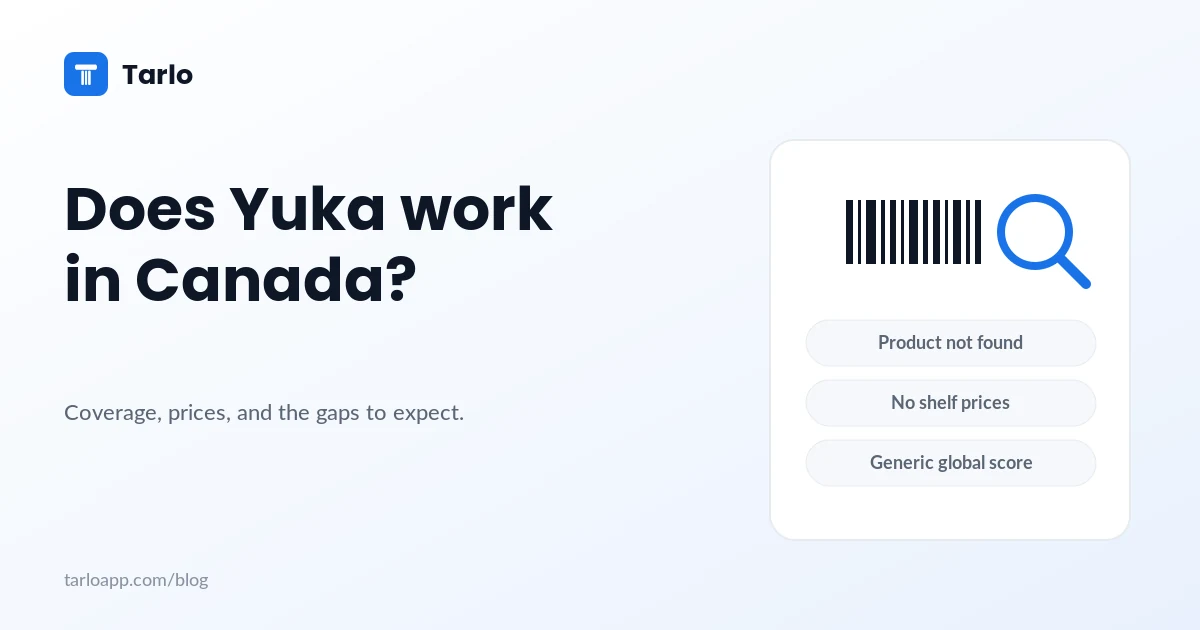
- “Product not found” or half-empty records — a scan that returns no result, or a score computed from partial data.
To be fair: no app fully escapes this — the underlying public data is what it is. The differences are in strategy: whether the app pre-loads the Canadian slice, whether it handles French label text, whether it admits missing data honestly, and how easily shoppers can fill gaps. That set of choices is exactly where Tarlo’s approach differs — including a plain “not enough data” verdict instead of a score computed from fragments.
Gap 3: store-blind and price-blind
Yuka has no concept of where you’re standing. It can’t tell you whether its suggested alternative exists in your store, and it knows nothing about prices — which, in a country where grocery inflation has been a top-three household concern for years, is a real omission.
So the interaction dead-ends: scan → bad score → now what? You’re left cross-referencing shelves manually. The follow-through — an alternative that meets your rules, confirmed on this shelf, at a shopper-reported price — is the part of the job Yuka structurally doesn’t attempt, and the part Tarlo was specifically built to do.
Why these gaps exist
Not laziness — strategy. Yuka is a French company scaled globally on a universal formula; one score everywhere is the product. Canadian FOP alignment, bilingual additive matching, store awareness and price crowdsourcing are all costly, country-specific work that a 50-million-user global app has little incentive to build for one market. A Canada-first app has every incentive — it’s the entire reason to exist. Neither choice is wrong; they just serve different shoppers.
What Canadian shoppers actually need
A checklist for judging any scanner app against Canadian reality:
- Coverage of what Canadians actually buy — including store brands and Quebec products.
- Alignment with Canadian rules — verdicts that agree with the FOP symbol on the package, not a parallel foreign scale.
- Bilingual label handling — “Allura Red” and “Rouge allura” are the same dye; “glucose-fructose” is HFCS.
- Honesty about missing data — “not enough data” beats a score built on fragments.
- Action after the verdict — a swap that clears your rules, and a price before the till.
Yuka checks the first item partially and the rest weakly — which is the honest summary of “does it work in Canada”: it runs; it isn’t built for here. For the full field comparison, see best food scanner app in Canada; for the head-to-head, Tarlo vs Yuka.
Frequently asked questions
Is Yuka available in the Canadian app stores?
Yes — iOS and Android, free with an optional premium subscription (free-tier comparison here). Availability isn’t the issue; fit is.
Will Yuka scan French-labelled Quebec products?
If the product is in its database, yes — the scan is by barcode, not label language. The friction shows up in coverage of Quebec-regional products and in additive matching against French ingredient text.
Does Yuka show Canadian prices?
No. Yuka has no price data anywhere. If seeing a shelf price before the till matters to you, that’s currently a Tarlo feature — shopper-reported, dated, and clearly labelled as an observation.
Should I switch or use both?
If Yuka’s universal score serves you, keep it — genuinely. Add or switch to Tarlo when you want Canadian-threshold verdicts, your own rules, store-brand coverage, or prices. Plenty of shoppers run both.
Sources
- Yuka — public pages and Canadian app-store listings, reviewed July–August 2026.
- Health Canada — front-of-package nutrition labelling: canada.ca
Tarlo reflects the rules you turn on and is for general information only — it is not medical or dietary advice. Regulatory details are Canadian and current as of the date above; always verify the product's physical label.