Best Food Scanner App in Canada (2026): Honest Comparison
Food scanner apps have exploded — there are now at least a dozen credible ones — but almost all were built for the US shelf, and almost all hand you a single universal score. If you shop in Canada, the questions that actually decide which app earns a place on your home screen are different: does it recognize Canadian and store-brand products? Does it check the things you care about, or the things its founder cares about? And when a product fails, does it leave you standing in the aisle with a red number — or help you act?
Here’s our honest read of the field. Full disclosure: we make Tarlo. We’ve kept every claim to features and approach — no app below is called “healthier” than another, because that’s not a thing an app can be.
Want to skip ahead? Tarlo is free on iOS and Android — but read on, because depending on what you need, a different app on this list may genuinely fit you better.
Quick comparison table
| Tarlo | Yuka | Bobby Approved | Fig | |
|---|---|---|---|---|
| Core approach | Rules you choose | Universal 0–100 score | Founder’s red-flag list | Diet & allergy profiles |
| Canada-first data | Yes | Global, generic | US-oriented | Broad, US-leaning |
| Health Canada FOP thresholds | Yes | No (own formula) | No | No |
| Suggests alternatives | Swaps on the same shelf | Generic alternatives | Limited | Product discovery |
| Shelf prices | Yes — shopper-sourced | No | No | No |
| Bilingual label handling (EN/FR) | Yes | Partial | No | No |
| Price | Free | Free + premium | Paid | Free + premium |
| Platforms | iOS + Android | iOS + Android | iOS + Android | iOS + Android |
The core split: a score vs your rules
Every scanner answers “should I buy this?” — the split is in who defines “good.”
Score apps (Yuka is the archetype) compress a product into one number that’s identical for every user. It’s simple and satisfying, but the app’s priorities are baked in: a diabetic, a parent avoiding synthetic dyes, and someone dodging seed oils all get the same verdict, weighted by someone else’s formula.
Rules apps flip the direction: you declare what matters, and the app checks exactly that. The result is not “this food is good” — it’s “this food meets your rules” — which is both more useful and more honest. That’s Tarlo’s model, and to a different degree Fig’s (through diet profiles).
Neither is wrong. A score is faster to start with; rules fit better the moment your priorities differ from the average. Most complaints you read about scanner apps — “why is this rated badly, I only care about X” — are really complaints about scores.
Yuka
The giant. 50M+ users, years of database growth, and the app that made scanning mainstream. The score (nutrition 60%, additives 30%, organic 10%) is instantly readable, the product pages are polished, and the community is enormous.
The Canadian trade-offs: the score is one-size-fits-all and isn’t aligned with Canada’s front-of-package thresholds; coverage of Canadian regional and store-brand products can be patchy (we dig into that in does Yuka work in Canada?); and it’s store-blind — it doesn’t know what’s on your shelf or what anything costs, so a bad score ends the interaction rather than redirecting it. Full head-to-head: Tarlo vs Yuka.
Bobby Approved
Built around food blogger Bobby Parrish’s personal ingredient standards: scan a product and see whether it clears his red-flag list. If your priorities happen to match his, it’s fast and decisive. The limits are the flip side: you can’t edit the list, the app is US-oriented (US label names, US products), and there’s no Canadian FOP logic, swaps or prices. It’s one person’s rules, applied to everyone — the opposite bet from Tarlo’s. Full head-to-head: Tarlo vs Bobby Approved.
Fig
The strongest app in the field for medical-grade dietary filtering: allergies, intolerances, celiac, low-FODMAP, and multiple family member profiles. If a wrong purchase means someone gets sick at your house, Fig deserves serious consideration — its condition templates go deeper than Tarlo’s rule presets in that direction (full comparison: Tarlo vs Fig). Its focus is diet compatibility rather than additive avoidance, Canadian thresholds, or shopping economics; there are no shelf prices or same-store swaps.
The newer wave
Trash Panda (deep, science-cited ingredient explanations with personality), Osana (additive/NOVA analysis with per-user preference flags), and CheckIt AI (visual AI scanning, recall alerts) are all evolving fast and worth watching. Common thread: thoughtful ingredient analysis, US-first focus, and no Canadian pricing or store-aware swaps yet.
Tarlo
What we built, in one paragraph: Canada-first data, verdicts computed against rules you toggle (dyes, glucose-fructose, seed oils, sweeteners, nitrites, BHA/BHT, plus Health Canada’s high-in thresholds for sodium and sugars), bilingual ingredient matching (Canadian labels are EN/FR, and additive names differ between them), and — the part no one else does — action after the verdict: swaps that meet your rules on the same shelf, with real shelf prices reported by shoppers. When data is missing, it says “not enough data” instead of guessing. The whole pipeline is documented openly in how Tarlo turns a barcode into a verdict.
What Tarlo is not: a calorie tracker, a diet planner, or a medical allergy tool — for the last one, see Fig above.
Who should pick what
- Complex allergies, celiac, FODMAP, family profiles → Fig.
- You want one simple score and a huge community → Yuka.
- You trust Bobby Parrish’s list and want zero setup → Bobby Approved.
- You want deep ingredient education → Trash Panda or Osana.
- You shop in Canada, want your own rules, and want a swap and a real price when something fails → Tarlo.
Frequently asked questions
Are these apps free?
See the dedicated free-tier breakdown for what each includes.
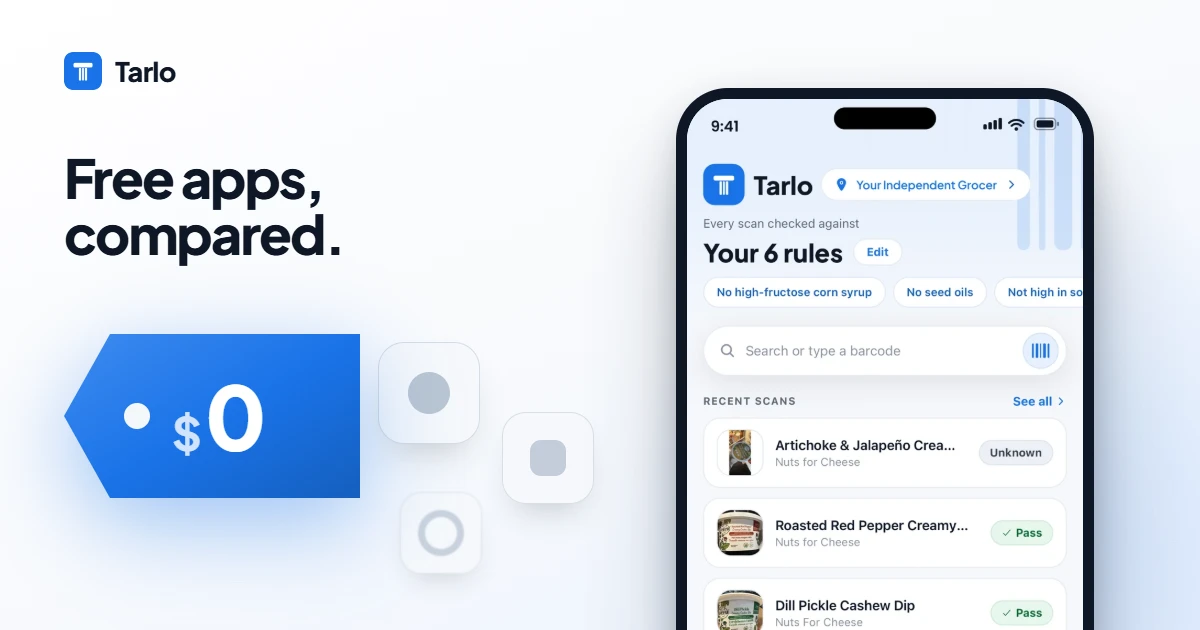
Tarlo is free. Yuka and Fig are free with premium tiers; Bobby Approved is paid. (Pricing changes — check the store listings.)
Do scanner apps work on Canadian store brands?
This is where every global app struggles most: store brands (President’s Choice, Compliments, Great Value…) are region-specific and thinly covered in global databases. Tarlo’s Canada-first catalog plus shopper contributions is aimed squarely at this gap — and when a product is missing, Tarlo says so and lets you add it rather than guessing.
Which app is best for one specific avoidance, like dyes or seed oils?
We compared the field per-job: best app to avoid food dyes and best app to avoid seed oils.
Which app matches Canada’s new front-of-package rules?
Of the apps compared here, Tarlo is the one that computes “high in” verdicts using Health Canada’s thresholds per reference amount. Score apps use their own formulas, which can disagree with the symbol on the package.
Can I use more than one?
Absolutely — Fig for a family allergy plus Tarlo for rules-and-prices is a sensible combo. They answer different questions.
Sources
- Public app listings and feature pages for each app (Apple App Store / Google Play), reviewed July–August 2026.
- Health Canada — front-of-package nutrition labelling: canada.ca
Tarlo reflects the rules you turn on and is for general information only — it is not medical or dietary advice. Regulatory details are Canadian and current as of the date above; always verify the product's physical label.