Seed Oils on Canadian Labels: Canola, Soy & Sunflower
“Seed oils” went from a niche nutrition-forum topic to one of the most talked-about phrases in grocery shopping. Whether you’re committed to avoiding them, mildly curious, or just tired of guessing what “vegetable oil” means, this guide explains what seed oils are, how they’re actually written on Canadian labels (including the tricks that make them hard to spot), what the debate is really about, and how to shop your preference without reading every box twice.
If you just want them caught for you: switch on the seed-oils rule in Tarlo and every scan checks for all of them — including the sneaky “vegetable oil” phrasings, in both label languages.
What “seed oils” means
“Seed oils” is an informal umbrella term for refined oils pressed or extracted from seeds — most commonly canola, soybean, sunflower, safflower, corn, cottonseed, grapeseed and rice bran. People sometimes call them “the hateful eight,” a phrase from the avoid-seed-oils movement.
What they have in common: they’re industrially refined (typically extracted with heat and solvents, then bleached and deodorized), relatively high in omega-6 polyunsaturated fats, inexpensive, neutral-tasting, and very stable in processed food. Olive, avocado and coconut oil are not seed oils — they’re pressed from fruit — which is why avoiders treat them differently.
Worth knowing as a Canadian: canola is a Canadian invention — bred in the 1970s from rapeseed at the University of Manitoba, its name a contraction of “Canada” and “ola.” It’s one of the country’s biggest crops, which is part of why it’s the default oil in so many Canadian products.
Why they’re in everything
Three reasons: cost (canola and soybean oil are among the cheapest fats available at scale), neutrality (no flavour to interfere with the product), and stability (long shelf life, predictable behaviour in frying and baking). That combination makes them the default fat in chips and crackers, granola bars, breads and baked goods, mayonnaise and salad dressings, margarine, frozen meals, plant-based milks and most restaurant fryers.
The practical consequence: if a packaged product contains added fat and doesn’t advertise which one, it’s usually a seed oil.
How they appear on Canadian labels
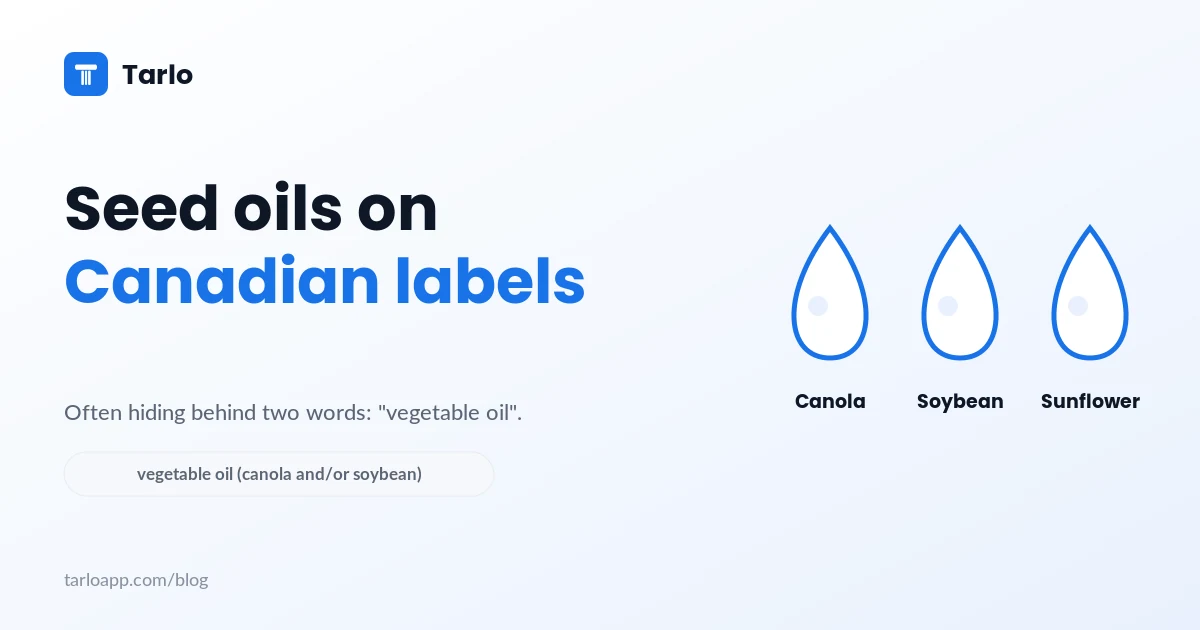
Sometimes the label names the oil directly — “canola oil,” “soybean oil,” “sunflower oil.” But Canadian regulations also allow the generic declaration “vegetable oil”, and that’s where it gets murky:
| On the label | What it usually means |
|---|---|
| Canola oil / soybean oil / sunflower oil | Named directly — easy case |
| Vegetable oil | Almost always one or more seed oils |
| Vegetable oil (canola and/or soybean) | A blend that can change batch to batch |
| High-oleic sunflower / safflower oil | A seed oil bred for different fat composition |
| Modified palm oil, palm kernel oil | Technically fruit oils, often grouped in by avoiders |
| Hydrogenated / partially hydrogenated oil | Processed further (PHOs are now banned in Canada) |
French labels use huile végétale, huile de canola, huile de soya, huile de tournesol — one more set of strings to watch if you’re reading Quebec packaging.
The and/or problem
The phrase “canola and/or soybean oil” is legal and common — it lets a manufacturer switch between oils depending on price and supply without reprinting packaging. For shoppers this means two real limitations: you can’t know which oil is in the specific unit you’re holding, and the blend can change between purchases even though the label looks identical.
If your rule is “no seed oils at all,” and/or doesn’t matter — either oil trips it. But it’s a good illustration of why memorizing “this brand is fine” is fragile: formulations move. (Reformulation is common enough that we track it as a category-wide behaviour — see how Tarlo handles product data.)
What the debate is about
Fairly stated, both sides:
The mainstream position — Health Canada and most major health bodies treat these oils as acceptable, even beneficial, replacements for saturated fat. Canola in particular is low in saturated fat and high in monounsaturated fat, and large reviews associate replacing butter with these oils with better cardiovascular markers.
The critics’ position — concerns centre on the omega-6 to omega-3 ratio of modern diets (seed oils being the biggest omega-6 source), the intensity of industrial refining, oxidation products when the oils are repeatedly heated, and the fact that these oils arrive mostly via ultra-processed food — so heavy seed-oil intake often travels with a dietary pattern people want to cut anyway.
Where it lands: the evidence for “seed oils are uniquely toxic” is weak; the case for “I’d rather get my fats elsewhere and eat less ultra-processed food” is a coherent preference no one needs permission for. Tarlo takes no side — it enforces your call, whichever it is.
What replaces them
Products marketing themselves as seed-oil-free typically use olive oil, avocado oil, coconut oil, butter or tallow. Two honest caveats: these products usually cost more (those fats are pricier inputs), and swapping the oil doesn’t automatically change anything else on the label — a coconut-oil cookie can still be high in sugars by Canada’s front-of-package rules. One rule rarely tells the whole story; that’s why Tarlo checks all your rules at once.
How to avoid them automatically
Manually, you’re looking for at least a dozen strings in two languages, including the generic “vegetable oil” formulations. In Tarlo, switch on the seed oils rule once: every scan checks the ingredient text — English and French — for canola, soybean, sunflower, safflower, corn oil, cottonseed, grapeseed and the “vegetable oil” phrasings, and answers meets / doesn’t meet your rules with the exact trigger named. Failures come with alternatives on the same shelf and real shopper-reported prices, so the seed-oil-free option’s premium is visible before the till. Category walkthrough: chips without seed oils; the app-by-app comparison: best app to avoid seed oils.
Frequently asked questions
Is canola oil the same as rapeseed oil?
Canola is a specific low-erucic-acid cultivar of rapeseed developed in Canada. Modern “rapeseed oil” sold for food in Europe is essentially the same low-erucic type; old-style high-erucic rapeseed oil isn’t used in food.
Are olive and avocado oil seed oils?
No — they’re pressed from fruit, and the avoid-seed-oils movement generally treats them as acceptable. Watch for blends, though: “olive oil blend” often means olive plus a seed oil, and the ingredient list tells you.
Does “no seed oils” mean the product is better overall?
Not by itself. It answers one question. The same product can still trip your other rules — sugars, sodium, dyes, glucose-fructose. Scanning against all your rules at once is the point.
Why doesn’t the front-of-package symbol flag seed oils?
Canada’s FOP symbol only covers sodium, sugars and saturated fat. Most seed oils are low in saturated fat, so seed-oil-heavy products often carry no symbol at all — the symbol and this preference measure different things.
Sources
- Canadian Food Inspection Agency — declaration of fats and oils on labels: inspection.canada.ca
- Health Canada — dietary fats guidance and the prohibition of partially hydrogenated oils: canada.ca
- Canola Council of Canada — history and composition of canola.
Tarlo reflects the rules you turn on and is for general information only — it is not medical or dietary advice. Regulatory details are Canadian and current as of the date above; always verify the product's physical label.