Canada's Front-of-Package 'High In' Symbol, Explained
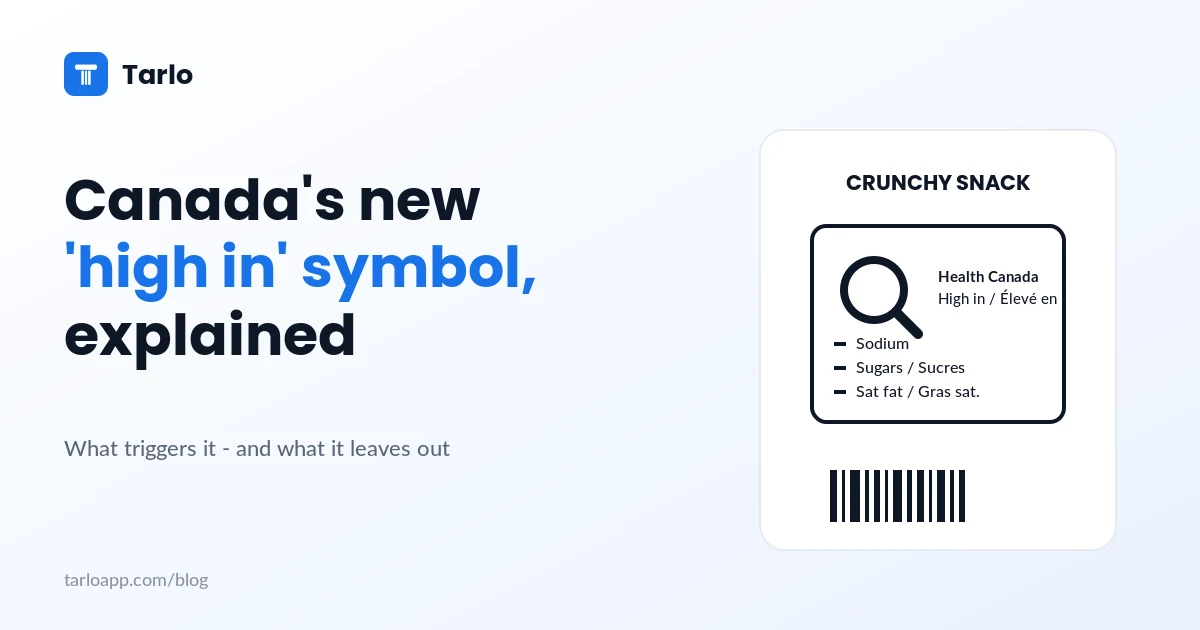
If you’ve noticed a small black-and-white magnifying glass on the front of Canadian groceries, that’s the new front-of-package (FOP) nutrition symbol. Since January 1, 2026, it’s mandatory on most prepackaged foods that are high in one or more of three nutrients: sodium, sugars, or saturated fat. It’s the biggest change to Canadian food labels in a decade — and it’s also widely misunderstood. (Just want the 30-second “what is that symbol” answer? Here it is; the 2026 rule-change roundup is here.)
This guide covers what triggers the symbol, the exact thresholds, the exemptions, what the symbol deliberately leaves out, and how to use it well on a real grocery run.
The fast version for shoppers: Tarlo applies these exact Health Canada thresholds — plus your own ingredient rules — every time you scan a barcode. The guide below is the full picture behind that one scan.
What the symbol actually means
The symbol is a magnifying glass with a short list underneath naming what the product is “high in” — “High in sodium”, “High in sugars”, “High in saturated fat”, or any combination of the three. Because Canadian packaging is bilingual, it appears in English and French together (“Élevé en sodium / sucres / gras saturés”). It always sits on the front of the package, in a standardized black-and-white design that manufacturers can’t restyle, shrink below a minimum size, or tuck into a corner where you won’t see it.
It is a factual flag, not a score. It doesn’t rank the food against other foods, doesn’t judge the overall product, and doesn’t consider anything beyond those three nutrients. Two very different products — say, a soup and a chocolate bar — can carry the identical “High in sodium” or “High in sugars” symbol for completely different reasons.
How we got here
Health Canada finalized the front-of-package labelling regulations in July 2022, giving the industry a three-and-a-half-year transition period to redesign packaging and, in many cases, reformulate products. The compliance deadline was January 1, 2026 — which is why the symbol seemed to appear everywhere at once this year.
The policy goal, as Health Canada frames it, is to give shoppers a fast, consistent signal for the three nutrients most strongly linked (when consumed in excess) to chronic conditions like heart disease, stroke, type 2 diabetes and high blood pressure. Canada follows countries like Chile, Mexico and Israel, which introduced mandatory front-of-package warning labels earlier — though Canada’s magnifying-glass design is deliberately less alarming than the black stop-sign style used in Latin America.
An interesting side effect documented in those countries, and expected here: manufacturers often reformulate products to duck under the threshold rather than carry the symbol. Chile saw measurable recipe changes across sugary drinks and cereals within two years of its law. That means recipes quietly change — one more reason a product you’ve bought for years deserves a fresh look at the label (or a re-scan).
The rollout timeline
The symbol didn’t appear overnight — it’s the last step of a decade of Canadian label reform:
| When | What happened |
|---|---|
| 2016 | Nutrition Facts table modernized; added colours must be named individually |
| 2018–2019 | Health Canada consults on front-of-package warning designs (four candidates tested) |
| July 2022 | Final regulations published; the magnifying-glass symbol wins; supplemented foods get their own separate caution identifier |
| 2022–2025 | Industry transition: package redesigns and quiet reformulations |
| January 1, 2026 | Compliance deadline — the symbol becomes mandatory on qualifying prepackaged foods |
| 2026 onward | Enforcement by the CFIA; expect stragglers, stickered imports, and continued reformulation |
Practical implication of the long transition: some compliant packages shipped early (you may have seen symbols in 2024–2025), and old stock without symbols can legally sell through for a while. During 2026, an unsymbolled package isn’t proof the product is under the thresholds — it may simply be old inventory. Scanning sidesteps that ambiguity entirely, since the verdict comes from the nutrition data, not the package print run.
What you’ll see, aisle by aisle
Where the symbols cluster, and which nutrient usually triggers them — useful for calibrating expectations before your next shop:
| Aisle | Most common trigger | Typical examples |
|---|---|---|
| Soups & broths | Sodium | Canned and instant soups, bouillon, ramen |
| Deli & cured meats | Sodium (often + sat fat) | Bacon, ham, sausages, pepperoni |
| Frozen meals & pizza | Sodium (30% main-dish bar) | Frozen dinners, pizzas, entrées |
| Snacks & chips | Sodium, sometimes sat fat | Chips, seasoned crackers, pretzels |
| Cereal & breakfast | Sugars | Sweetened cereals, granola, instant oatmeal |
| Drinks & juices | Sugars | Pop, iced teas, juice drinks (100% juice has partial rules) |
| Yogurt & dairy drinks | Sugars | Flavoured yogurts, drinkable yogurt, chocolate milk |
| Baking & desserts | Sugars + sat fat | Cake mixes, icing, cookies, ice cream |
| Condiments & sauces | Sodium or sugars (10% small-RA bar) | Soy sauce, ketchup, BBQ sauce, pickles |
| Cheese & butter | Mixed | Some cheeses flagged for sat fat/sodium; butter exempt |
Two patterns worth internalizing: sodium is the workhorse trigger — it drives more symbols than sugars and saturated fat combined in savoury aisles — and the small-reference-amount 10% rule is why tiny-serving items like pickles and soy sauce carry symbols that intuitively “shouldn’t” apply to a spoonful.
How Canada compares to other countries
If you shop across borders or read international nutrition content, it helps to know the systems are not interchangeable:
| Country/region | System | Mandatory? | Style |
|---|---|---|---|
| Canada (2026) | “High in” magnifying-glass symbol | Yes | Threshold flag — factual, no judgment |
| Chile (2016) | Black stop-sign “ALTO EN” warnings | Yes | Threshold flag — deliberately alarming |
| Mexico (2020) | Black octagon warnings | Yes | Threshold flag, plus caffeine/sweetener seals |
| UK | Traffic-light labels (red/amber/green) | Voluntary | Graded per nutrient |
| France/EU (partial) | Nutri-Score (A–E) | Voluntary | Overall algorithmic grade |
| United States | No front-of-package system yet | — | FDA proposal in progress |
The deep design difference: Chile, Mexico and Canada flag threshold facts; the UK and Nutri-Score render judgments (grades). Canada chose the factual end of the spectrum — which is philosophically the same bet Tarlo makes: state the fact, let the shopper apply their own rules, rather than compress everything into one grade.
The thresholds
The trigger is a percentage of the Daily Value (DV) per reference amount — a standardized quantity Health Canada defines for each food category, which is not necessarily the serving size printed on the package:
| Situation | Threshold to be labelled “high in” |
|---|---|
| Most prepackaged foods | ≥ 15% DV of sodium, sugars, or saturated fat |
| Foods with small reference amounts (≤ 30 g/mL — e.g. pickles, condiments, some cookies) | ≥ 10% DV |
| Prepackaged main dishes (reference amount ≥ 200 g — e.g. frozen dinners) | ≥ 30% DV |
The Daily Values behind the math are 2,300 mg of sodium, 100 g of total sugars, and 20 g of saturated fat.
The reference-amount detail matters more than it looks: because the threshold is measured against a standardized quantity, a manufacturer can’t dodge the symbol by shrinking the printed serving size. Health Canada’s reference amount for, say, potato chips applies to every brand of chips equally.
A worked example
Take a can of soup with 650 mg of sodium per Health Canada reference amount (250 mL for soup):
- Daily Value for sodium = 2,300 mg.
- 650 ÷ 2,300 = 28% DV.
- Soup is a regular food (threshold 15%). 28% ≥ 15% → the can must carry “High in sodium.”
Now a granola bar with 11 g of sugars per its reference amount: 11 ÷ 100 g = 11% DV. If the bar’s reference amount is small (≤ 30 g), the 10% threshold applies and it’s flagged; if it falls in the regular category, 11% stays under 15% and there’s no symbol. Same bar, different category rules — which is exactly why eyeballing it is hard and automating the math helps.
Which foods are exempt
Not every high-in food carries the symbol. The main exemptions:
- Plain fruits and vegetables — fresh, frozen, canned or dried, with no added sodium, sugars or saturated fat. A bag of frozen mango is “high in sugars” by the arithmetic, but it’s exempt because those are naturally occurring sugars in a whole food.
- Plain milk and some dairy — exempt as important sources of calcium and vitamin D that Health Canada doesn’t want to discourage. This is why 2% milk carries no symbol while a sweetened iced coffee might.
- Foods that are obviously what they are — butter, sugar, salt, honey and similar staples, where a “high in” flag would state the obvious.
- Practical exemptions — very small packages, foods sold only at farmers’ markets, raw single-ingredient meats, and a few other regulatory categories.
The exemptions are sensible, but they create a subtle trap: “no symbol” does not mean “low in.” Butter has no symbol because it’s exempt, not because it’s low in saturated fat.
What the symbol leaves out
The FOP symbol is deliberately narrow. It says nothing about:
- Synthetic food dyes like Allura Red (Red 40) or Tartrazine;
- Sweeteners — a “zero sugar” drink sweetened with aspartame will never carry a sugar symbol;
- High-fructose corn syrup, which on Canadian labels reads “glucose-fructose” — the symbol flags total sugars, not which sweetener was used;
- Seed oils, nitrites, preservatives and every other ingredient-level concern;
- Price, or whether a better-matching alternative sits on the same shelf.
Two products can both be symbol-free and still be worlds apart on the ingredient list. The symbol is a floor, not a full answer.
Using it well in the aisle
A practical way to think about it: use the symbol as a fast first filter, then apply your own rules to what’s left. If you’re watching sodium, the symbol does that first pass for you at a glance. If you also avoid dyes or glucose-fructose, the symbol won’t help — that’s ingredient-list territory.
That two-step process is exactly what Tarlo automates: scan a barcode and it applies the same Health Canada “high in” thresholds plus whatever ingredient rules you switched on, then answers with a single meets / doesn’t meet your rules. When a product doesn’t meet them, it shows alternatives on the same shelf with real shelf prices.
Frequently asked questions
Does the symbol mean a food is unhealthy?
No — and Health Canada is careful not to frame it that way. It means the product crosses a defined threshold for one of three specific nutrients per reference amount. Context still matters: a “high in sodium” miso soup you eat occasionally is a different decision than a daily snack.
Why doesn’t cheese or milk carry the symbol?
Dairy sits partly under the exemptions: plain milk is exempt as a key calcium source, and some cheeses fall under partial exemptions. Flavoured or sweetened dairy drinks generally do get flagged when they cross the sugar threshold.
Do imported products need the symbol?
Yes — any prepackaged food sold in Canada must comply, regardless of where it’s made. Imports without Canadian-compliant labels can’t legally be sold here (small specialty importers sometimes apply stickers).
Is this the same as Yuka’s score or Nutri-Score?
No. Nutri-Score (used in parts of Europe) and app scores like Yuka’s are overall ratings that blend many factors into one grade. Canada’s symbol is a narrow threshold flag on three nutrients, defined in law. They can disagree with each other — more on that in Tarlo vs Yuka.
What about restaurant food, bakery items and alcohol?
The symbol applies to prepackaged foods. Restaurant meals, in-store bakery and deli items packaged at the store, and most alcoholic beverages fall outside the requirement — which is worth remembering, because some of the highest-sodium items Canadians eat (restaurant meals) carry no warning at all.
What’s the caution box I see on vitamin waters and energy drinks?
That’s a different system: supplemented foods (with added caffeine, vitamins, minerals or amino acids) carry their own “Supplemented Food Caution Identifier” introduced in 2022. Same magnifying-glass family visually, different rules — it warns about added supplemental ingredients, not sodium/sugars/sat fat.
Will products keep changing because of the symbol?
Very likely. In Chile and Mexico, manufacturers reformulated aggressively to get under the thresholds — less sugar, less sodium, or different sweeteners. Watch that last one: a drink that drops sugar to lose the symbol often adds artificial sweeteners instead, which the symbol doesn’t track. If sweeteners are on your avoid list, the symbol disappearing can actually mean the product moved further from your rules.
How does this relate to the Nutrition Facts table?
The symbol is a threshold pre-read of the table’s worst news. The table itself rewards a five-minute skill — our line-by-line guide covers it, including the 5%–15% habit.
Where can I check a product before I’m in the store?
Scan it with Tarlo — the verdict uses the same Health Canada thresholds, computed per reference amount, plus your own ingredient rules.
Sources
- Health Canada — Front-of-package nutrition labelling: canada.ca
- Canadian Food Inspection Agency — Nutrition symbol requirements for industry: inspection.canada.ca
- Health Canada — Table of Daily Values and Table of Reference Amounts (Food and Drug Regulations).
Tarlo reflects the rules you turn on and is for general information only — it is not medical or dietary advice. Regulatory details are Canadian and current as of the date above; always verify the product's physical label.