High-Fructose Corn Syrup vs 'Glucose-Fructose' in Canada
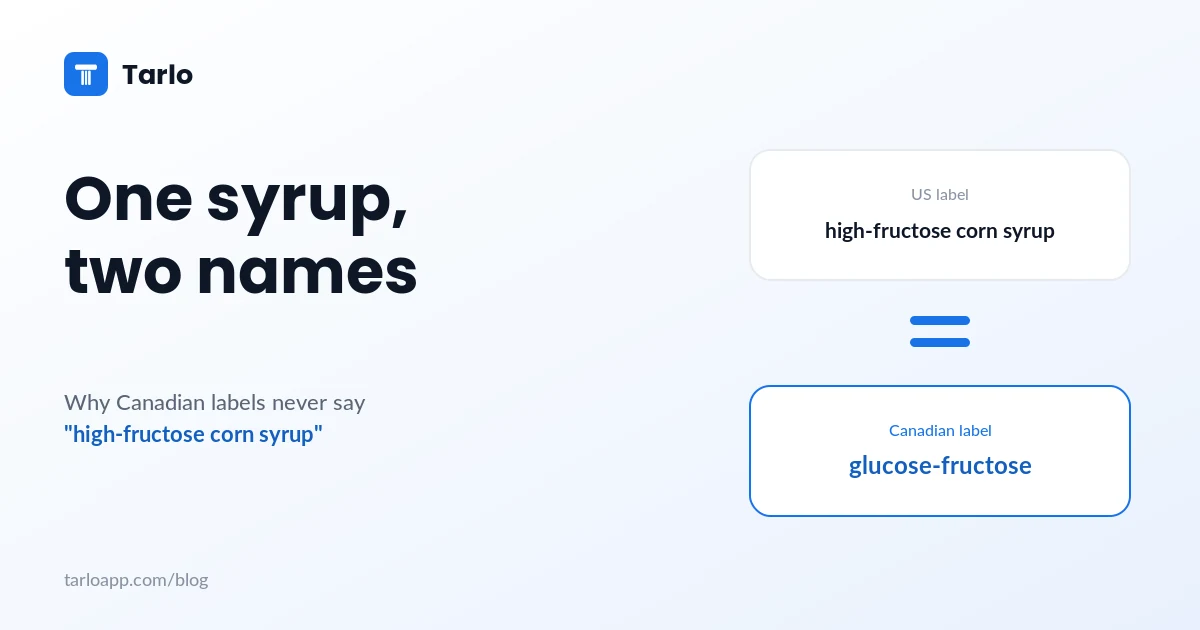
Search a Canadian ingredient list for “high-fructose corn syrup” and you’ll almost never find it — even in soft drinks and snacks that clearly contain it. That’s not because Canadian versions are HFCS-free. It’s because Canada uses a different name for the same ingredient: “glucose-fructose.” This is probably the single most consequential US-vs-Canada label difference for everyday shoppers, and this guide covers it end to end.
The one-tap version: Tarlo’s HFCS rule watches for “glucose-fructose” on every scan, so you never have to remember the Canadian name at the shelf.
Are they the same thing?
For practical purposes, yes. In the United States the ingredient is labelled “high-fructose corn syrup” (HFCS). In Canada, the equivalent corn-derived sweetener — a syrup containing both glucose and fructose — must be declared as “glucose-fructose.” Same feedstock (corn), same manufacturing approach (corn starch broken into glucose, then partially converted to fructose with enzymes), same role in the recipe.
One technical nuance: HFCS comes in grades — HFCS-55 (about 55% fructose, typical in soft drinks) and HFCS-42 (about 42%, typical in baked goods). Canada’s “glucose-fructose” term covers these without stating the ratio. Table sugar (sucrose), for comparison, is 50% glucose and 50% fructose — so the common versions are all in a similar band. The debate about HFCS was never that its fructose share is wildly different from sugar; it’s about cost, ubiquity and total added-sugar intake.
Why Canada names it differently
Canadian food regulation names sugars by composition rather than by process or marketing history. A syrup containing glucose and fructose is, in the regulation’s plain logic, “glucose-fructose.” The US term stuck for historical and industry reasons (“high-fructose” distinguished it from ordinary corn syrup, which is nearly all glucose).
The side effect: American food discourse — books, documentaries, viral posts — taught millions of people to scan labels for “high-fructose corn syrup,” and that phrase simply never appears here. A Canadian shopper armed with US advice walks the aisle convinced their products are HFCS-free. They usually aren’t.
The sugar-name decoder table
| On a US label | On a Canadian label (EN) | French |
|---|---|---|
| High-fructose corn syrup | Glucose-fructose | Glucose-fructose |
| Corn syrup | Glucose syrup / corn syrup | Sirop de glucose / sirop de maïs |
| Sugar | Sugar | Sucre |
| Invert sugar | Invert sugar / liquid invert sugar | Sucre inverti |
| Dextrose | Dextrose | Dextrose |
| Fruit juice concentrate | Fruit juice concentrate | Concentré de jus de fruits |
And these are just the common ones — added sugar hides behind dozens of names (maltose, rice syrup, barley malt extract, agave, honey, evaporated cane juice…). Ingredient lists are ordered by weight, so splitting sugar across several names pushes each one further down the list, making the product look less sweet than it is. Canada’s Nutrition Facts table now groups them: the “Sugars” line plus its % Daily Value covers total sugars regardless of the names used in the list.
Where glucose-fructose shows up
The classic carriers: soft drinks and iced teas, freezies and popsicles, ketchup and BBQ sauces, jams and syrups, granola bars, sweetened cereals, baked goods, canned fruit in syrup, and some yogurt drinks. Canadian formulations sometimes differ from their US twins — a few brands use sugar here where the US version uses HFCS — but you can’t assume either way. Only the list (or a scan) tells you.
Why people avoid it
The honest framing: most nutrition authorities treat glucose-fructose as metabolically similar to other added sugars — the strongest consensus concern is total added sugar, not this sweetener uniquely. People who target it specifically usually give one of three reasons: it’s a reliable marker of ultra-processed products; they’re cutting added sugar and this is the biggest industrial source; or they simply prefer recipes built without the cheapest possible sweetener. All are legitimate preferences — and precisely because the evidence doesn’t crown one sugar as the villain, Tarlo treats “no glucose-fructose” as your rule, applied consistently, not a health verdict.
What the front-of-package symbol does and doesn’t catch
Canada’s new “high in sugars” front-of-package symbol flags total sugars at or above the threshold (roughly 15 g per reference amount for regular foods). It does not tell you which sweetener is inside. Two implications:
- A product can be below the sugar threshold — no symbol — and still contain glucose-fructose (ketchup is a classic case: sweet, but small reference amount servings).
- A product can carry the symbol while containing only “natural” sugars you’re fine with.
If the ingredient itself is what you avoid, the symbol can’t help you; the ingredient list can, and a rules-based scan does it faster.
How to spot it automatically
In Tarlo, switch on the high-fructose corn syrup rule once. Every scan then checks the ingredient text — in English and French — for “glucose-fructose” and its variants, alongside any other rules you’ve enabled (dyes, seed oils, sweeteners…). The answer is a plain meets / doesn’t meet your rules with the trigger named, and failures come with same-shelf alternatives and real shopper-reported prices. The mechanics are documented in how Tarlo turns a barcode into a verdict.
Frequently asked questions
Is glucose-fructose worse than sugar?
The mainstream scientific position is that they’re metabolically similar at typical intakes — the actionable number is total added sugar. Choosing to avoid glucose-fructose specifically is a reasonable preference (often as an ultra-processing marker), just not a scientifically settled hierarchy of sugars.
Does “no HFCS” on a US import mean no glucose-fructose here?
A product formulated without HFCS shouldn’t contain glucose-fructose either — but Canadian and US versions of the same brand are often different recipes. Check the Canadian label or scan the Canadian barcode.
What’s the difference between “glucose syrup” and “glucose-fructose”?
Glucose syrup (corn syrup) is nearly all glucose — no meaningful fructose. “Glucose-fructose” is the HFCS-style syrup with substantial fructose. They’re different ingredients on the label and in the recipe.
Can Tarlo tell me how much glucose-fructose a product contains?
No label discloses per-ingredient amounts. Tarlo can tell you it’s present (your rule), and separately whether the product is high in total sugars by Health Canada’s threshold — the two together cover both questions.
Sources
- Canadian Food Inspection Agency — sugars-based ingredients: names and grouping rules: inspection.canada.ca
- Health Canada — sugars in the Nutrition Facts table and % Daily Value: canada.ca
Tarlo reflects the rules you turn on and is for general information only — it is not medical or dietary advice. Regulatory details are Canadian and current as of the date above; always verify the product's physical label.