60+ Hidden Names for Sugar on Canadian Labels
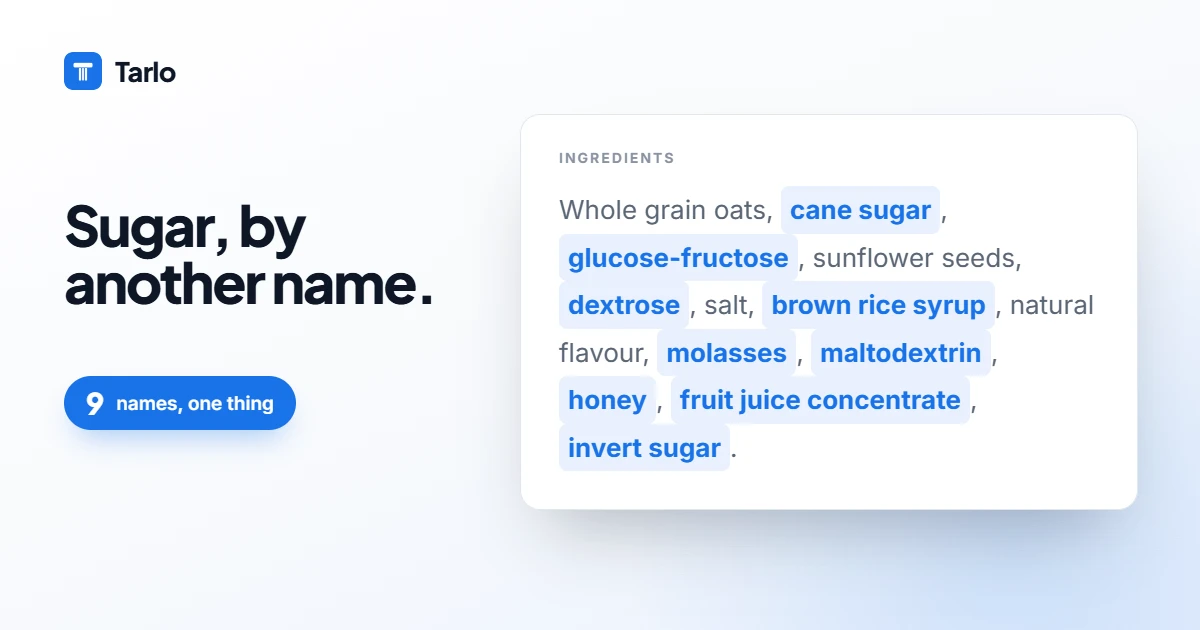
Ask most shoppers to find the sugar in an ingredient list and they’ll look for one word. Manufacturers know this — which is why added sugar travels under more than sixty names on Canadian labels, and why a product can list sugar four times without the word “sugar” appearing once. This is the reference guide: the full alias list organized so it’s actually usable, the ingredient-order trick that exploits it, and what Canadian labels now do to help.
The automated version: Tarlo reads the whole list on every scan — including the high-in-sugars threshold — so the sixty names become one verdict.
The ingredient-order trick
Canadian ingredient lists are ordered by weight, heaviest first. If a granola bar used 20 g of “sugar,” sugar might land first or second on the list — a bad look. Split the same 20 g across brown sugar, glucose-fructose, honey and barley malt extract, and each individual sugar drops far down the list, none of them near the top. Same total sweetness, dramatically better optics.
That’s the entire game, and it’s legal. The defence is knowing the aliases — or letting the Nutrition Facts “Sugars” line (which sums them all) and a scanner do the work.
The master list
The -oses (chemical sugars): glucose, fructose, sucrose, dextrose, maltose, lactose, galactose, trehalose.
Syrups: glucose-fructose (Canada’s name for HFCS), glucose syrup, corn syrup, malt syrup, rice syrup / brown rice syrup, tapioca syrup, oat syrup, golden syrup, refiner’s syrup, carob syrup, agave syrup/nectar, maple syrup.
“Sugar, but dressed up”: brown sugar, demerara, turbinado, muscovado, icing sugar, cane sugar, evaporated cane juice, cane juice crystals, castor sugar, beet sugar, coconut sugar, date sugar, invert sugar, golden sugar, raw sugar.
Fruit-derived: fruit juice concentrate (apple/grape/pear are the workhorses), fruit purée concentrate, dates/date paste, raisin juice concentrate.
Malt & fermentation family: barley malt extract, malt extract, maltodextrin (technically a starch, glycemically sugar-like — full guide), molasses, treacle.
Dairy & other: honey, lactose, sweetened condensed milk, caramel.
Every one of these contributes to the total sugars number (except maltodextrin, which sneaks around it — see its guide). None of them is nutritionally distinct enough to matter much: your body meets glucose and fructose at the end of all of them.
The “healthy-sounding” sugars
The premium aliases deserve their own callout because they’re doing the most work: agave (marketed as low-glycemic; it’s ~85% fructose — more than glucose-fructose), coconut sugar (trace minerals, still ~sucrose), honey and maple syrup (real flavour differences, similar metabolic arithmetic), “fruit-juice sweetened” (apple juice concentrate is sugar water with a health halo), and date-sweetened (whole dates bring fibre; date syrup mostly doesn’t). If a package leads with how it’s sweetened, that’s usually the tell that it’s sweetened plenty.
What Canadian labels do to help
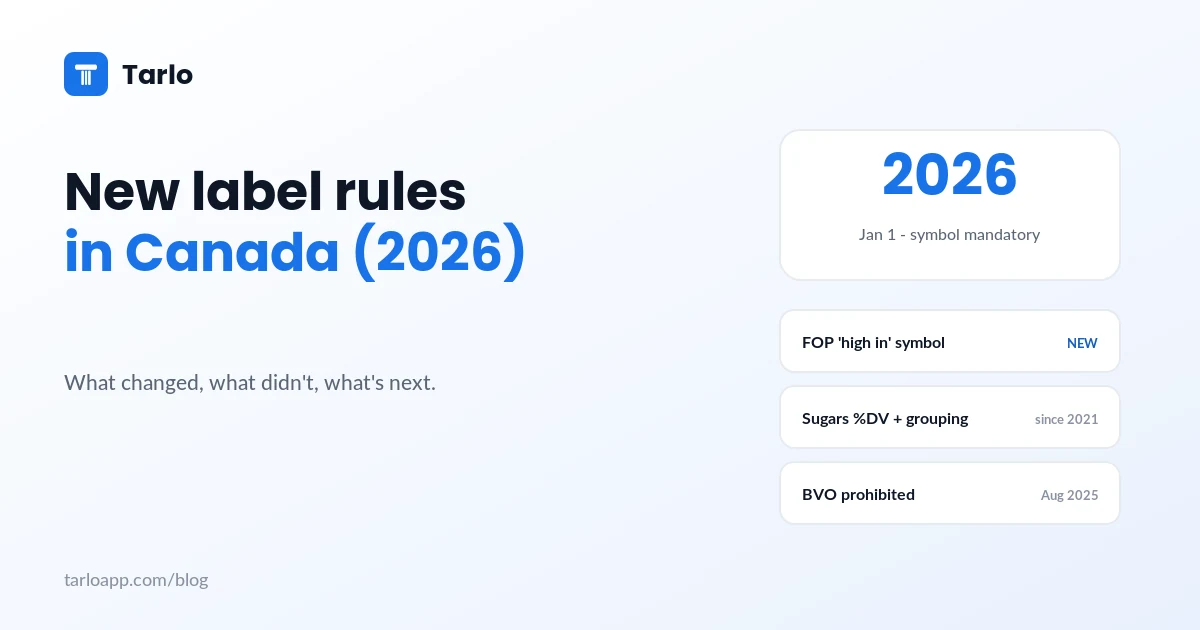
Two genuinely useful rules: since the 2016–2021 label modernization, the Nutrition Facts table shows Sugars with a % Daily Value (based on 100 g/day) — the single number that sums every alias; and ingredient lists must now group sugars-based ingredients in brackets after the word “Sugars” — e.g., Sugars (glucose-fructose, honey, malt extract) — which partially defuses the order trick. And at ≥15% DV per reference amount, the front-of-package “high in sugars” symbol — mandatory since January 2026 — fires regardless of naming creativity.
What doesn’t count as added sugar
Fairness requires the other direction too: plain fruit, plain milk and plain yogurt contain naturally occurring sugars (fructose, lactose) that arrive with fibre, protein and micronutrients — that’s why FOP exemptions spare them, and why “total sugars” on plain yogurt isn’t the same signal as on a cola. Sweeteners are a separate topic entirely: a “zero sugar” product avoids every name on this page and may still be intensely sweet via aspartame or sucralose.
The fast way to check
Memorizing sixty names works for nobody. In Tarlo: the high-in-sugars rule applies Health Canada’s threshold to the summed total (all aliases included, per reference amount), and the HFCS rule watches specifically for glucose-fructose. Scan, get meets / doesn’t meet your rules, and see lower-sugar picks from the same shelf with real prices. The sixty names become someone else’s problem — specifically, ours.
Frequently asked questions
Is honey healthier than sugar?
It has trace compounds sugar lacks and a slightly different fructose ratio, but metabolically they’re close cousins. Choose it for flavour; don’t count it as a health upgrade at equal grams.
Why does the ingredient list say “Sugars (…)” with brackets?
That’s the Canadian sugars-grouping rule — all sugars-based ingredients grouped so their combined weight determines list position. It’s the regulator’s answer to the splitting trick.
Does “no added sugar” mean low sugar?
No — a 100% juice can carry a day’s worth of naturally occurring sugar with zero “added.” Check the Sugars line and % DV, or the FOP symbol.
Are sugar alcohols (sorbitol, erythritol) sugars?
No — they’re a separate class (polyols), lower-calorie, laxative at volume, listed under their own names. A “no sugar” product using them isn’t lying, but it isn’t unsweetened either.
Sources
- Canadian Food Inspection Agency — sugars-based ingredients grouping rules: inspection.canada.ca
- Health Canada — sugars % Daily Value and Nutrition Facts modernization: canada.ca
Tarlo reflects the rules you turn on and is for general information only — it is not medical or dietary advice. Regulatory details are Canadian and current as of the date above; always verify the product's physical label.