What Is Maltodextrin — and Why Is It in Everything?
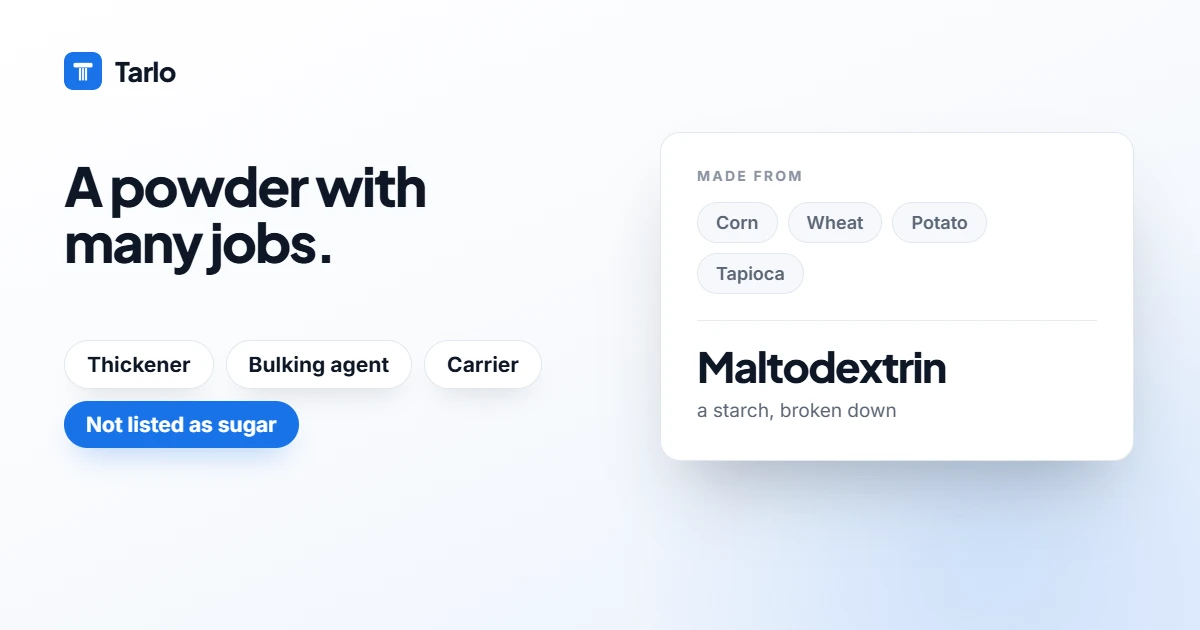
Maltodextrin is the loophole ingredient: it isn’t listed as a sugar, doesn’t count in the “Sugars” line, can appear in products labelled “no added sugar” — and yet has a glycemic index higher than table sugar. It’s also one of the most common ingredients in the modern grocery store. Here’s what it actually is, why manufacturers adore it, who genuinely needs to care, and who doesn’t.
Watching carbs or ultra-processing markers? Add maltodextrin to your rules in Tarlo and it’s flagged on every scan.
What maltodextrin is
Maltodextrin is a processed starch — usually corn in North America (sometimes wheat, rice, potato or tapioca) — broken down by enzymes or acid into short chains of glucose units. Chains short enough to be instantly digestible, long enough that regulators classify it as a carbohydrate/starch, not a sugar. It’s a white, nearly tasteless powder that dissolves easily and adds bulk without sweetness.
That last property is the key to its résumé: it’s the food industry’s universal filler, thickener and carrier.
Why it’s in everything
One ingredient, a dozen jobs: bulking agent in powdered products (spice mixes, drink crystals, instant soups — it’s what makes a teaspoon of intense flavour into a scoopable powder); carrier for sweeteners (the bulk in sucralose and stevia packets is mostly maltodextrin); texture and mouthfeel in sauces, dressings and “light” products; crisping agent in snack coatings; anti-caking in shredded cheese; and fast fuel in sports gels and mass-gainer powders, where instant digestibility is the point. It’s cheap, neutral and functional — the definition of an industrial workhorse.
The sugar loophole
Here’s the part that earns the article: because maltodextrin is chemically a starch, it appears in the Nutrition Facts as carbohydrate, not sugars. A product can say “no added sugar,” show a low Sugars line, avoid the front-of-package sugars symbol — and still deliver a glucose hit, because maltodextrin’s glycemic index runs ~85–105, versus ~65 for sucrose. Your bloodstream meets it as glucose, fast; the label just doesn’t file it under S.
It also doesn’t appear in the sixty sugar aliases because, technically, it isn’t one. It’s the sixty-first name that plays by different rules.
To be fair in both directions: quantities are often small (a carrier in a spice mix is grams, not spoonfuls), and for most healthy people an anti-caking dusting is metabolically trivial. The loophole matters at volume — powdered drinks, sports products, “keto-washed” snacks bulked with it.
Who should care — and who needn’t
Worth attention if you: manage diabetes or blood glucose (the classic case — “sugar-free” products that spike anyway); follow low-carb/keto seriously (maltodextrin is anti-keto by design); have celiac disease — in Canada, wheat-derived maltodextrin must declare its source under allergen rules, so check for “(wheat)”; or use maltodextrin-heavy products daily (protein shakes, powdered drinks).
Probably fine to ignore if: your exposure is trace amounts in seasoning and the occasional packet — the dose is small and the evidence of harm at that level is thin. Some gut-microbiome research (mostly animal/in-vitro) explores effects at high intakes; nothing there has moved regulators, and Health Canada, the FDA and EFSA all treat maltodextrin as an ordinary permitted food ingredient.
Spotting it on Canadian labels
Look for “maltodextrin” (English and French use the same word — maltodextrine), sometimes “corn maltodextrin” or with a source in brackets. High-list-position maltodextrin (top three ingredients) is the volume signal; bottom-of-list is the carrier signal.
Scanning is faster across a cart: add maltodextrin as a rule in Tarlo and every scan checks the bilingual text — useful precisely because this ingredient hides in categories nobody thinks to check (deli seasonings, shredded cheese, “lightly seasoned” anything). Pair with the sugars rule to cover both the named sugars and the loophole in one pass.
Frequently asked questions
Is maltodextrin a sugar?
Legally and on the label, no — it’s a starch. Metabolically, it behaves like fast glucose. Both statements are true, which is the whole story of this ingredient.
Is maltodextrin gluten-free?
Corn-based (the North American default) is. Wheat-derived maltodextrin is so processed that most residual gluten is removed, but Canadian allergen labelling still requires the wheat source declared — celiac shoppers should look for the bracket.
Why is it in my stevia packet?
Bulk. Pure stevia extract is intensely sweet in milligram amounts; maltodextrin (or dextrose) makes it spoonable. A “natural sweetener” packet is often mostly processed corn starch — worth knowing, even if the grams are tiny.
Is “resistant maltodextrin” the same thing?
No — resistant maltodextrin (e.g., in fibre supplements) is chemically rearranged to resist digestion and acts as fibre. Same family name, opposite metabolic behaviour.
Sources
- Health Canada — food additive and ingredient labelling requirements: canada.ca
- Canadian Food Inspection Agency — allergen source declaration (wheat): inspection.canada.ca
- Hofman et al. (2016), Critical Reviews in Food Science and Nutrition — maltodextrin digestion and glycemic response.
Tarlo reflects the rules you turn on and is for general information only — it is not medical or dietary advice. Regulatory details are Canadian and current as of the date above; always verify the product's physical label.