Are Food Dyes Banned in Canada? Every Dye's 2026 Status
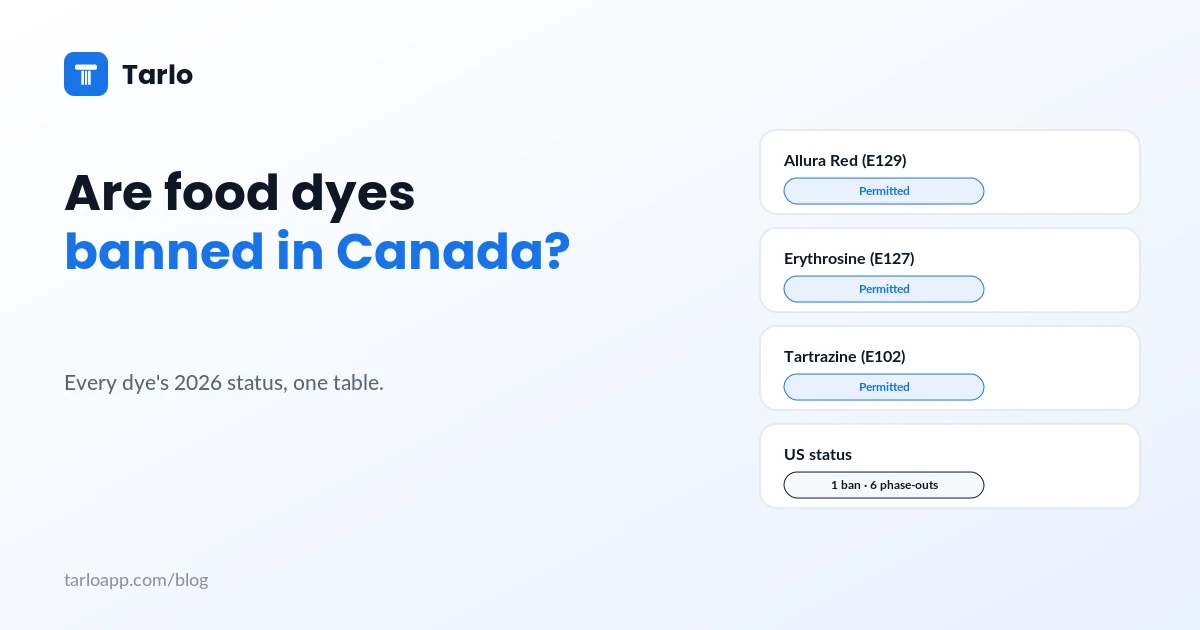
No synthetic food dye is currently banned in Canada. Every colour making US headlines — Red 40, Red 3, Yellow 5, Yellow 6, the blues — remains permitted by Health Canada, with the requirement that each be named individually on the label. Meanwhile the US has revoked one dye outright and is pressuring six more out of the food supply. This page is the one-stop status table for the whole family, and we keep it current as regulators move.
Avoiding them regardless of legality? Tarlo’s dyes rule is on by default — every scan, both label languages.
The status table (2026)
| Dye (US name) | Canadian label name | Code | Canada | United States | EU |
|---|---|---|---|---|---|
| Red 40 | Allura Red | E129 | Permitted | Voluntary phase-out (2026–27) | Permitted + child warning |
| Red 3 | Erythrosine | E127 | Permitted | Revoked (food deadline Jan 2027) | Restricted (cherries only) |
| Yellow 5 | Tartrazine | E102 | Permitted | Voluntary phase-out | Permitted + child warning |
| Yellow 6 | Sunset Yellow FCF | E110 | Permitted | Voluntary phase-out | Permitted + child warning |
| Blue 1 | Brilliant Blue FCF | E133 | Permitted | Voluntary phase-out | Permitted |
| Blue 2 | Indigotine | E132 | Permitted | Voluntary phase-out | Permitted |
| Green 3 | Fast Green FCF | E143 | Permitted | Voluntary phase-out | Not permitted |
Deep dives: Red 40’s status · Red 3’s status · Tartrazine’s evidence · the science debate on Allura Red.
What’s actually happening in the US
Two separate actions get merged in headlines. Red 3 was genuinely revoked (January 2025) — a legal mandate triggered by rat-tumour studies under the Delaney Clause, with food compliance due January 2027. The other six dyes are under a voluntary phase-out announced April 2025 — the FDA asked industry to drop them by about the end of 2026; no regulation compels it, though state laws (California, Utah and others) add real pressure in school food. So “the US banned food dyes” is half true: one ban, six requests.
Why Canada holds its position
Health Canada reviewed the Red 3 evidence after the US decision and kept it permitted, judging the rat mechanism irrelevant to humans at Canadian intake levels; it reviewed the child-behaviour literature behind the EU’s warning labels and kept the family permitted without warnings. Canada’s consistent posture: dyes are safe as regulated, and the 2016 individual-naming rule gives shoppers the information to decide. Whether you find that reassuring or too relaxed is precisely the judgment your own rules exist to encode.
What Canadian shoppers should take from this
Three practical consequences. The label names differ from the headlines — US coverage says Red 40/Yellow 5; your ingredient list says Allura Red/Tartrazine (the full name map). Reformulation will arrive here unevenly — one-recipe economics pulls Canadian products along; nothing forces it, so cereal-aisle-style splits will persist through the transition. “Not banned” settles nothing about your cart — permitted just means the decision is yours; a scan with the dyes rule on answers it per product, with same-shelf swaps when it fails.
Frequently asked questions
So is anything actually banned in Canadian food?
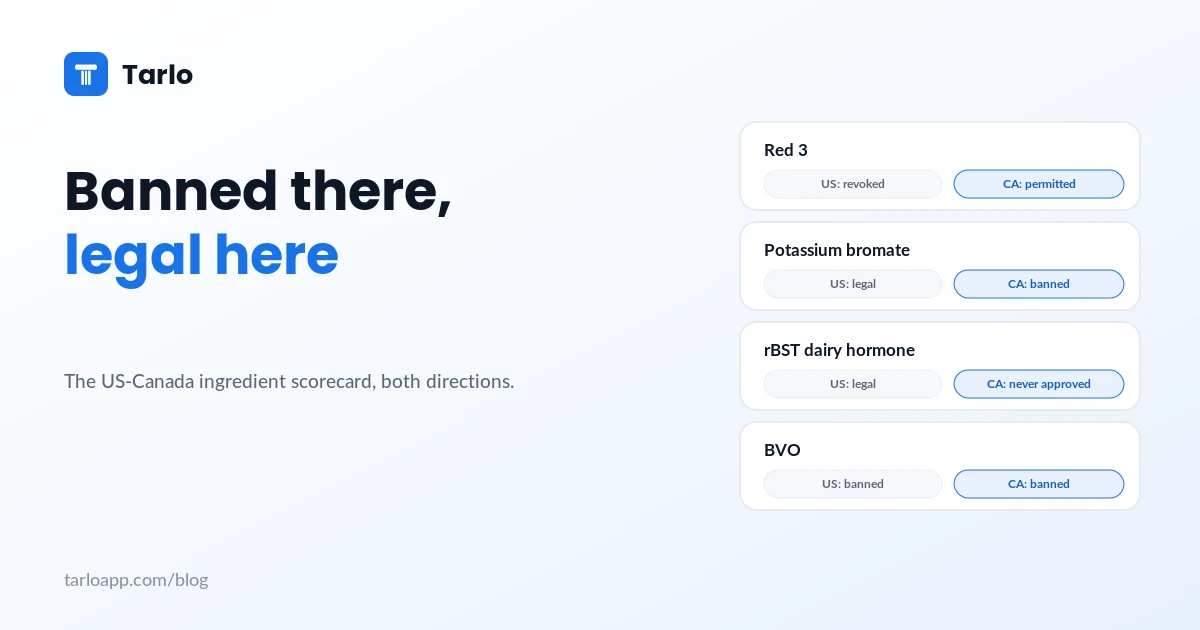
Yes — just not dyes. BVO was banned in 2025, potassium bromate has long been prohibited, and Canada never approved rBST in dairy. The cross-border scorecard is in ingredients banned in the US but legal in Canada.
Will Canada follow the US phase-out?
No announcement suggests it. Health Canada moves on its own reviews, and its recent Red 3 decision signals confidence in the current position. We’ll update this page if that changes.
Are “natural” dyes automatically fine?
They pass a synthetic-dyes rule, but carmine (insect-derived) and annatto have their own objectors — the natural-colour caveats explain.
What’s the fastest way to shop dye-free in Canada today?
Tarlo, dyes rule on (it’s a default): scan, see the exact trigger named, grab a listed alternative that passes — how the scanner apps compare on this job. The dye-free snacks guide covers the aisle strategy.
Sources
Tarlo reflects the rules you turn on and is for general information only — it is not medical or dietary advice. Regulatory details are Canadian and current as of the date above; always verify the product's physical label.