Is Red 40 Banned in Canada? (2026 Status)
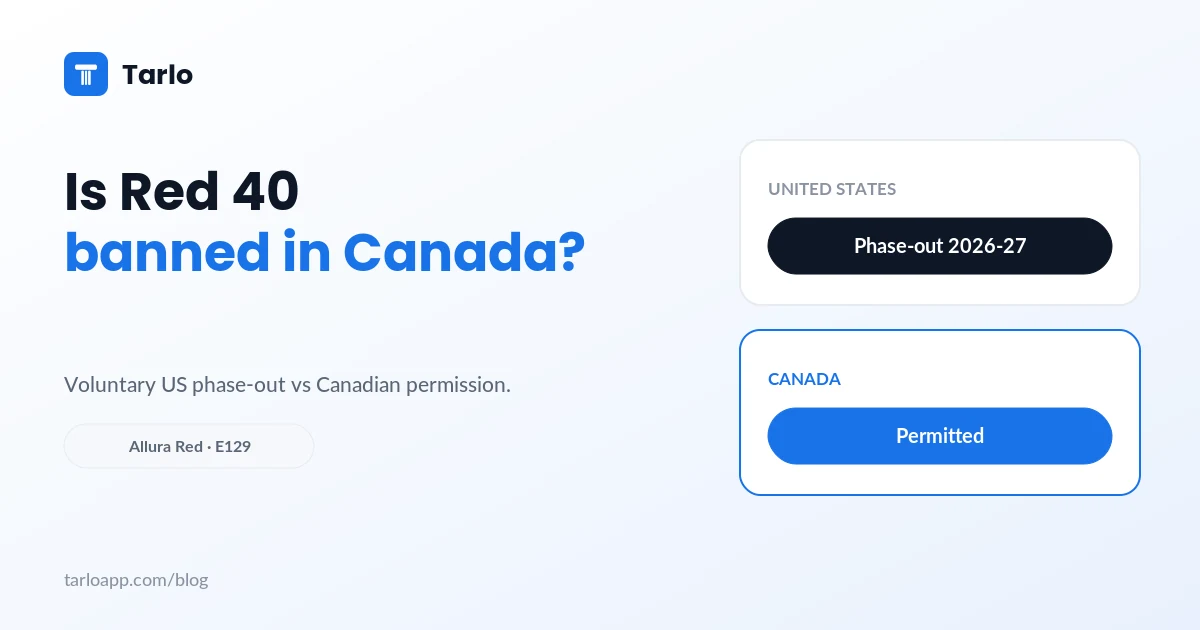
No — Red 40 is not banned in Canada, and it isn’t technically banned in the US either. What the FDA announced in 2025 is a voluntary phase-out: it asked manufacturers to remove Red 40 and five other petroleum-based dyes from US foods by the end of 2026–2027. Health Canada permits the dye, where it appears on labels as Allura Red. Here’s the full status, what “voluntary” really means for your shelf, and the Canadian wrinkle most US coverage misses.
The practical shortcut first: Tarlo’s synthetic-dyes rule (on by default) flags Allura Red on any Canadian barcode.
The status table
| Jurisdiction | Red 40 status (2026) |
|---|---|
| Canada | Permitted — labelled as Allura Red / Rouge allura |
| United States | Authorized, under voluntary phase-out (target end 2026–2027); several state laws restrict it in schools |
| European Union | Permitted with a warning label (“may have an adverse effect on activity and attention in children”) |
| E-number | E129 everywhere |
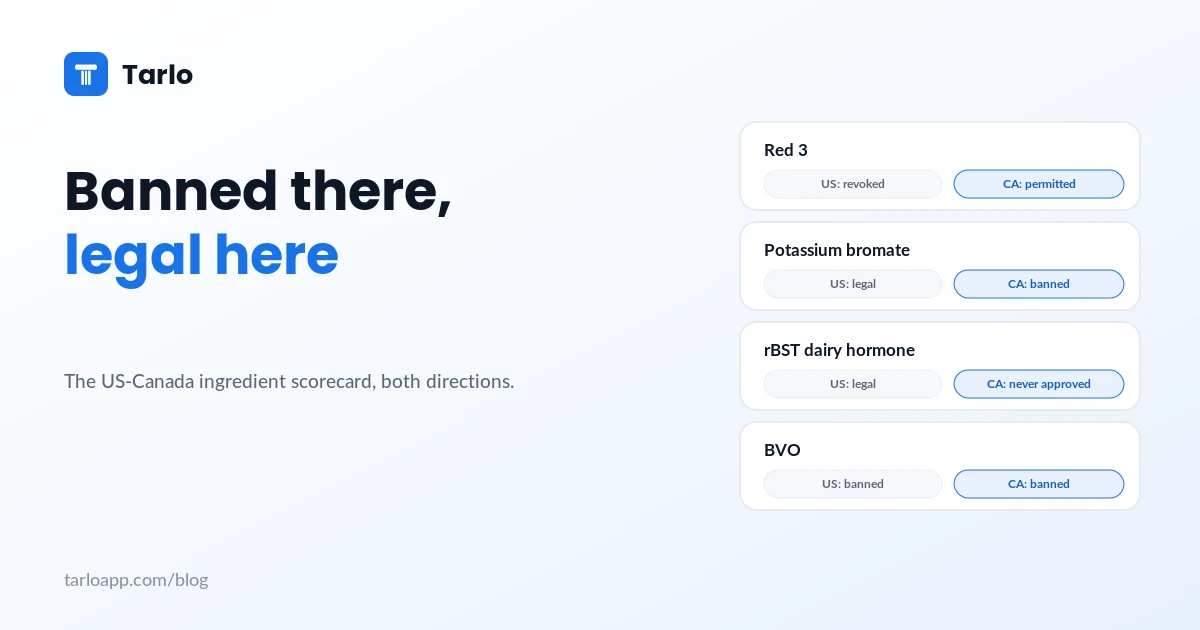
Note the contrast with Red 3, which the FDA actually revoked — Red 40’s situation is pressure, not prohibition.
What “voluntary phase-out” means
In April 2025 the FDA announced it would work with industry to eliminate six synthetic dyes — Red 40, Yellow 5, Yellow 6, Blue 1, Blue 2, Green 3 — from US food by around the end of 2026 (in practice sliding into 2027). There’s no regulation forcing it; enforcement is reputational, plus state-level laws (California, Utah and others) restricting dyes in school food. Big brands have pledged reformulations; timing varies by company and product line.
Practical translation: US shelves will lose these dyes gradually and unevenly — not on a single date, and not by law.
Canada’s position
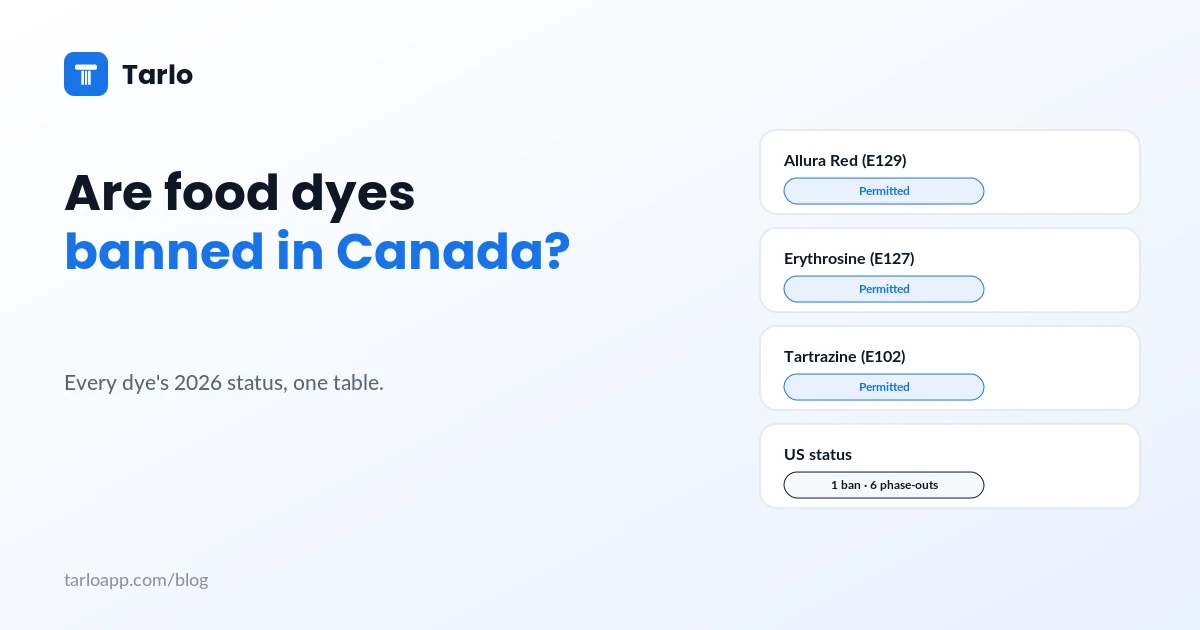
Health Canada permits Allura Red and the rest of the family, with limits, and requires each colour to be named individually on labels since 2016. No Canadian phase-out has been announced. Canada’s general posture on the dye debate — reviewed the behaviour evidence, kept permissions, no EU-style warning — is covered in our full Allura Red guide; the whole family’s ban-status is summarized in are food dyes banned in Canada?
The Canadian label wrinkle
The part US coverage misses: even when American advice reaches Canadians, the name doesn’t. US labels say Red 40; Canadian labels say Allura Red (English) or Rouge allura (French). Shoppers scanning Canadian ingredient lists for “Red 40” find nothing and conclude it’s absent — the single most common dye-avoidance mistake here. If you’re checking by eye, search for Allura Red; if you’re scanning with Tarlo, the additive code E129 catches it in any language.
What happens to Canadian products
Three currents worth knowing: one-recipe economics (many brands will eventually run the reformulated US recipe in Canada too — cheaper than maintaining two), lag and exceptions (Canadian lines can keep dyes longer, since nothing here compels the change — the cereal aisle has history of exactly this split), and imports (US-made products on Canadian shelves will reformulate on the US timeline). Net effect: the dye’s presence in Canada will shrink through 2026–2027, unevenly, with the Canadian label as the only truth for any specific package.
Frequently asked questions
Is Red 40 dangerous?
That’s a different question from “is it banned” — and it’s genuinely contested: the EU requires a child-behaviour warning, the US is pressuring it out, Canada permits it. The evidence and the sensitivity debate are covered in is Red 40 (Allura Red) bad for you? — the choice is yours, which is the point of rules.
Which dyes are in the US phase-out?
Red 40, Yellow 5 (Tartrazine), Yellow 6 (Sunset Yellow), Blue 1, Blue 2, Green 3 — plus separate action on Red 3 and minor dyes. All remain permitted in Canada; see the family status page.
If the US drops dyes, why would Canadian boxes still have them?
Because nothing requires the change here, and transition inventory + market-specific lines exist. Same brand, different market, different recipe — scan the barcode in your hand.
How do I avoid it in Canada today?
Turn on the synthetic dyes rule in Tarlo — the whole family, both languages — and use the dye-free swaps guide for what to grab instead.
Sources
Tarlo reflects the rules you turn on and is for general information only — it is not medical or dietary advice. Regulatory details are Canadian and current as of the date above; always verify the product's physical label.