Dye-Free Snacks in Canada: How to Find Them Fast
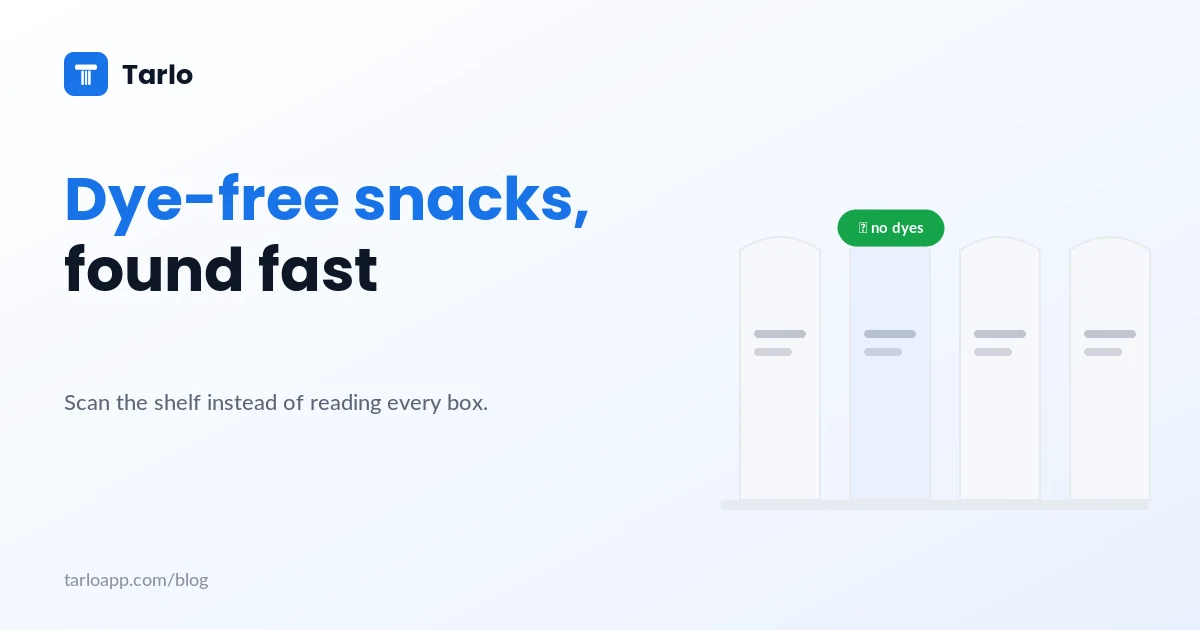
Finding snacks without synthetic dyes in Canada is harder than it should be, for one sneaky reason: the dyes go by different names here than in the US, so the advice most parents read online doesn’t match the labels in front of them. This is the practical guide — the exact Canadian label names, where dyes actually hide, what “naturally coloured” really means, and a way to clear a whole shelf in the time it used to take to read one box.
The fast answer: switch on the dyes rule in Tarlo, scan, done. Everything below is the label knowledge behind that one tap.
Step 1: learn the Canadian names
The single most useful table for a dye-avoiding shopper in Canada:
| Common US name | Canadian label (English) | Canadian label (French) | Code |
|---|---|---|---|
| Red 40 | Allura Red | Rouge allura | E129 |
| Yellow 5 | Tartrazine | Tartrazine | E102 |
| Yellow 6 | Sunset Yellow FCF | Jaune soleil FCF | E110 |
| Blue 1 | Brilliant Blue FCF | Bleu brillant FCF | E133 |
| Blue 2 | Indigotine | Indigotine | E132 |
| Red 3 | Erythrosine | Érythrosine | E127 |
Two pieces of context that make this table work. First, since 2016 Health Canada requires each added colour to be declared by its individual name — the old catch-all word “colour” is no longer allowed, so the names above must appear if the dye is present. Second, the US names (“Red 40”) never appear on Canadian labels — if you’ve been scanning for them, you’ve been scanning for strings that don’t exist here. The deep dive on the biggest one: is Red 40 (Allura Red) bad for you?
Step 2: know where dyes hide
The obvious carriers are, well, obvious: anything neon. But the full map is wider than most people expect:
- The classics — candy, gummies, freezies, drink crystals, sports drinks, rainbow cereals (aisle guide), icing, sprinkles.
- The semi-hidden — flavoured yogurts and yogurt tubes, snack crackers with “cheese” colouring, pickles (Sunset Yellow appears in some brands), maraschino cherries, seasoned chips, some granola bars with candy pieces.
- The genuinely surprising — some breads and wraps (“golden” colour), smoked or cured fish, canned pie fillings, and brown soft drinks (usually caramel colour — a different additive class, but worth knowing it’s also an added colour).
The pattern: dyes follow visual marketing, not food category. Anything whose colour is part of the sell is a candidate.
Step 3: read “natural colour” carefully
“No artificial colours” usually means the product uses naturally derived colourants instead: beet juice, paprika extract, turmeric/curcumin, spirulina, annatto, carmine. For most shoppers avoiding synthetic dyes, that’s exactly what they want. Two caveats keep it honest:
- Carmine is made from cochineal insects — relevant for vegetarians, and a known allergen for some people. It must be named on Canadian labels.
- Annatto is plant-derived but is itself associated with sensitivities in some individuals.
So “naturally coloured” answers the synthetic question, not every question. If your rule is specifically “no synthetic dyes,” natural colourants pass; if your concerns are broader, the ingredient list still matters — which is an argument for rules you define yourself rather than a front-of-pack phrase.
Step 4: scan the shelf instead of every box
Manual method: pick up each package, find the ingredient list, scan it for six-plus names in two languages, repeat for the whole shelf. Call it a minute per product, with misses.
Scanning method: in Tarlo, toggle the synthetic dyes rule once (it’s one of the two rules on by default for new users, precisely because it’s the most common ask). Then:
- Scan a snack. Tarlo checks the pre-parsed additive codes plus the EN/FR ingredient text against the whole dye family and answers meets / doesn’t meet your rules — with the trigger named, e.g. “Tartrazine (E102).”
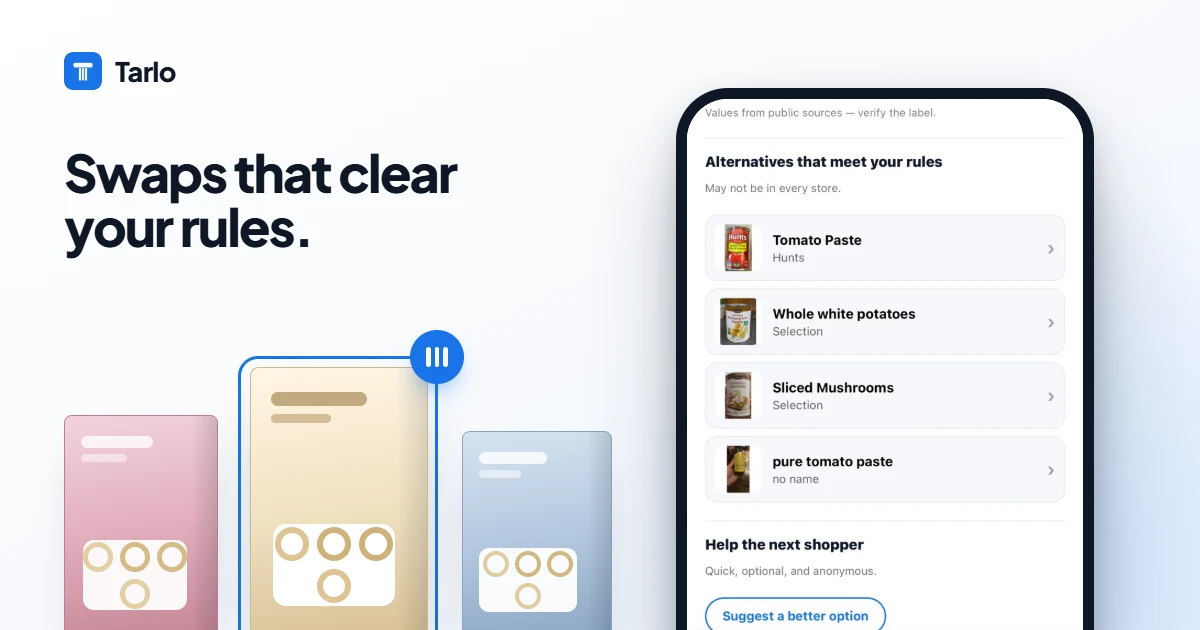
- Fail? See the swaps. Tarlo lists alternatives from the same shelf that pass your rules, each with a shopper-reported shelf price, so choosing dye-free doesn’t mean guessing on cost.
- Move down the aisle. A few seconds per product, both languages handled, no memorization.
The verdict logic is deterministic and documented — see how Tarlo turns a barcode into a verdict; the app-by-app comparison for this exact job is the best app to avoid food dyes.
A realistic shopping example
Back-to-school run, snack aisle. You scan a box of fruit gummies: doesn’t meet your rules — Allura Red (E129), Tartrazine (E102). Below the verdict, Tarlo shows fruit snacks from the same shelf that pass the dyes rule, one at $3.49 (reported last week at your store) and one at $4.29. You grab the $3.49 one and scan the next item. Total added time versus grabbing blind: about ten seconds. Total labels read by a human: zero.
That’s the whole promise — not “this snack is bad,” just your rule, enforced quickly, with a way out.
Why claims on the front aren’t enough
A package can honestly say “no artificial colours” and still trip your other rules — glucose-fructose, seed oils, artificial sweeteners, or Health Canada’s high-in-sugars threshold. Front-of-pack claims answer one question each; your cart deserves all of them answered at once. That’s what rule-based scanning is for.
Frequently asked questions
Are synthetic dyes banned in Canada?
No — they’re permitted with limits, and since 2016 they must be individually named on labels. The EU permits them too but requires a child-behaviour warning on six of them; the US is actively restricting some — the full ban-status table. Details in the Allura Red guide.
Which default rules does Tarlo start with?
New users start with synthetic dyes and high-fructose corn syrup (glucose-fructose) on — the two most-requested avoidances — and can toggle the rest (seed oils, sweeteners, nitrites, BHA/BHT, sodium, sugars) anytime.
Do I have to be in a specific store for swaps?
Swaps are drawn from products that pass your rules in the same category; where shoppers have confirmed availability and prices at your store, that’s shown with freshness context. Prices are always labelled as shopper observations, not guaranteed prices.
What if a product isn’t in the database?
Tarlo says “not enough data” honestly rather than guessing — and lets you add the product with two photos, which fixes it for the next shopper too.
Sources
- Health Canada — food colours: individual naming requirement (2016) and permitted colours: canada.ca
- Canadian Food Inspection Agency — colour declaration on labels: inspection.canada.ca
Tarlo reflects the rules you turn on and is for general information only — it is not medical or dietary advice. Regulatory details are Canadian and current as of the date above; always verify the product's physical label.