Is Tartrazine (Yellow 5) Bad for You? Canadian Guide
Tartrazine is the second-most-searched food dye in North America after Red 40 — and unlike Red 40, its name doesn’t change at the border: Canadian labels say tartrazine too. It’s the lemon-yellow behind drink crystals, snack coatings and candy, it’s on the EU’s warning-label list, it’s in the US FDA’s phase-out plan, and it has one extra wrinkle the other dyes don’t: a small but documented sensitivity population. Here’s the complete picture.
Short version: Tarlo’s synthetic-dyes rule catches tartrazine (E102) on every scan, both languages, free.
What tartrazine is
Tartrazine is a synthetic azo dye producing a bright lemon yellow — cheap, stable through heat and light, and one of the oldest synthetic colours still in use (first made in the 1880s). Like the other azo dyes, it’s petroleum-derived and purely cosmetic: it exists to make products look the flavour they claim.
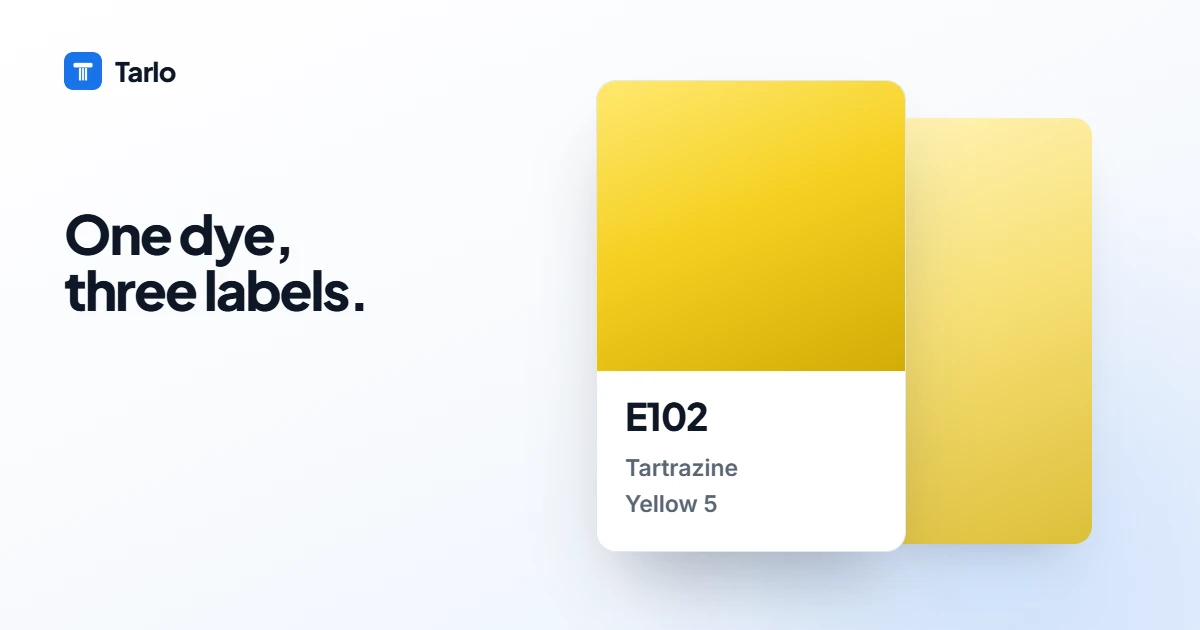
The name game
| Where | Label name |
|---|---|
| Canada (English) | Tartrazine |
| Canada (French) | Tartrazine |
| United States | Yellow 5 / FD&C Yellow No. 5 |
| E-number systems | E102 |
Note the reversal of the Red 40 situation: Americans searching “tartrazine” find it easily on Canadian labels, but Canadians following US advice to “avoid Yellow 5” won’t find those words here. Since 2016, Health Canada requires it to be named individually — no hiding behind “colour.”
Where it shows up
Beyond the obvious (yellow candy, drink crystals, sports drinks): snack chip seasonings (nacho and cheese flavours often blend tartrazine with Sunset Yellow), instant noodle seasoning, pickles and relish, some mustards, cake mixes and custard powders, flavoured popcorn, and medications and vitamins (where it has its own labelling rules). Its partner-in-crime is usually Sunset Yellow (E110) — the orange sibling — so avoiding one usually means watching both.
The behaviour evidence
Tartrazine was one of the six colours in the 2007 Southampton study, which linked mixtures of synthetic dyes (plus a preservative) to increased hyperactivity in some children. That study is why the EU requires a warning — “may have an adverse effect on activity and attention in children” — on foods containing it, and why California’s 2021 OEHHA review concluded synthetic dyes can affect behaviour in some sensitive children. Health Canada reviewed the same literature and kept tartrazine permitted without a warning.
Same pattern as the other dyes: nobody claims all children are affected; the debate is how to act on a sensitive subset that can’t be identified in advance. The EU warns, the US is phasing out, Canada permits — and the label decision defaults to you.
The sensitivity question
Tartrazine has one extra dimension: a small number of people show hypersensitivity reactions — hives, itching, nasal congestion — most documented among people with aspirin sensitivity or chronic hives. Prevalence estimates are well under 1%, but the phenomenon is real enough that tartrazine is the one dye clinicians occasionally test for specifically. For that group, avoidance isn’t a philosophy; it’s symptom management — and bilingual, automatic label-checking is genuinely useful.
What regulators are doing
- Canada: permitted, individually named on labels since 2016, no warning required.
- EU: permitted with the child-behaviour warning statement.
- US: included in the FDA’s 2025-announced voluntary phase-out (status explainer) of six petroleum-based dyes (with Red 40, Sunset Yellow, and the blues), targeted for the end of 2026–2027; several states passed their own restrictions. Voluntary means timing varies by brand — and Canadian formulations won’t automatically follow the US ones.
That last point matters here: as US products reformulate, their Canadian twins may lag or differ. The only reliable check is the Canadian label — or a scan of the Canadian barcode.
How to avoid it automatically
Turn on the synthetic dyes rule in Tarlo once. Every scan checks pre-parsed additive codes (E102 and the whole family) plus the EN/FR ingredient text, and answers meets / doesn’t meet your rules with the trigger named. Fails come with dye-free picks from the same shelf and shopper-reported prices. For the family overview, see the dyes hub table; for the science-and-regulators deep dive, the Allura Red guide covers the shared ground.
Frequently asked questions
Is tartrazine banned in Canada?
No — permitted with limits, individually named on labels. Not banned in the US or EU either; the EU requires the warning statement, and the US phase-out is voluntary industry action.
Does tartrazine contain gluten or animal products?
No — it’s a synthetic chemical, vegan and gluten-free by nature. (Sensitivity concerns are unrelated to allergens like gluten.)
Why is it in pickles?
Colour uniformity — it keeps pickles looking uniformly bright. Several brands use riboflavin or nothing instead, which makes pickles one of the easiest tartrazine swaps in the store.
What replaces tartrazine in “no artificial colours” products?
Usually turmeric/curcumin, riboflavin, or annatto — plant-derived yellows. Note annatto itself bothers a small number of people; “natural” answers one question, not all of them.
Sources
Tarlo reflects the rules you turn on and is for general information only — it is not medical or dietary advice. Regulatory details are Canadian and current as of the date above; always verify the product's physical label.