Is Aspartame Banned in Canada? (2026 Answer)
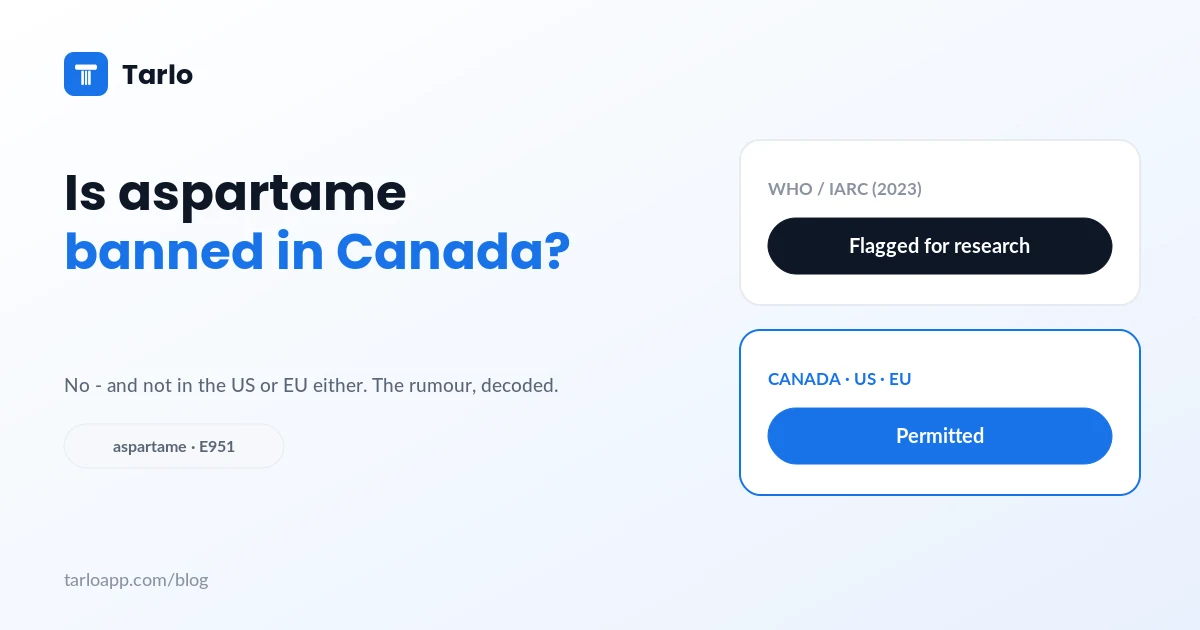
No — aspartame is not banned in Canada. It isn’t banned in the US, the EU, the UK or Australia either. No major food regulator prohibits it. The rumour resurfaces every time a headline cycle hits — most recently the WHO’s 2023 “possibly carcinogenic” classification — so here’s the actual status, where the confusion comes from, and the honest path if you’d rather avoid it anyway.
That path in one line: Tarlo’s artificial-sweeteners rule flags aspartame and its blend-partners on any scan, free.
The status, in one table
| Jurisdiction | Aspartame status (2026) |
|---|---|
| Canada | Permitted — ADI 40 mg/kg body weight/day |
| United States | Permitted (FDA reaffirmed after 2023 review) |
| European Union | Permitted (EFSA ADI 40 mg/kg) |
| WHO bodies | IARC: Group 2B hazard flag (2023) · JECFA: ADI unchanged at 40 mg/kg |
The two WHO rows are the entire story of the confusion — one agency flagged, the other measured, and only the second one sets limits.
Where the ban rumours come from
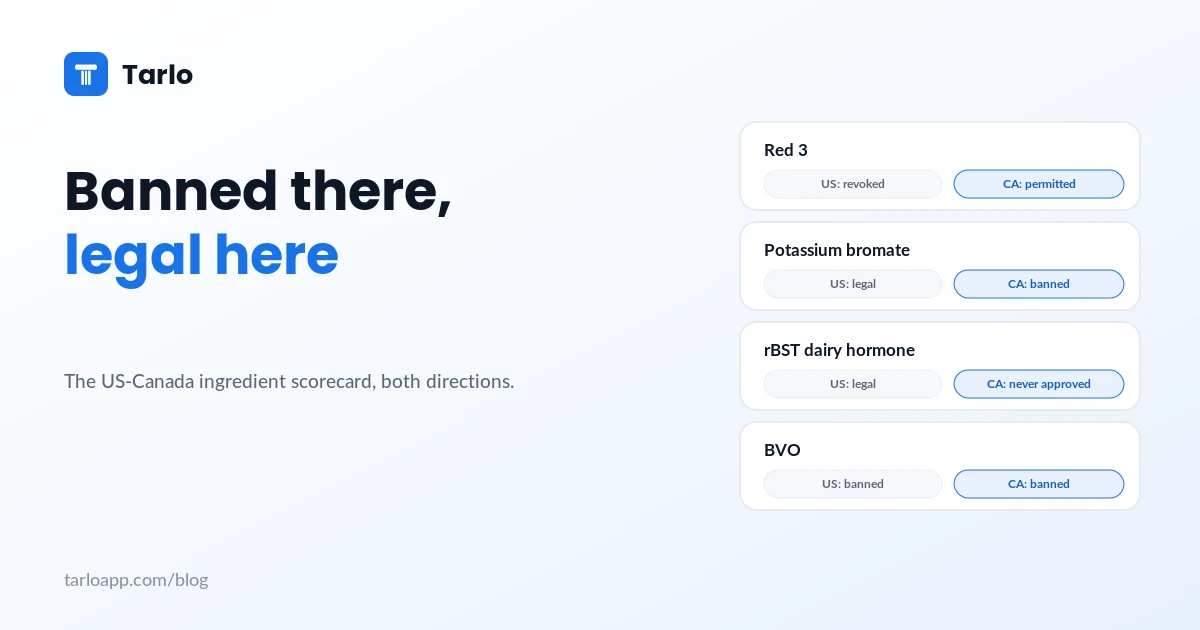
Three recurring sources. The 2023 IARC classification — “possibly carcinogenic (Group 2B)” made global headlines; fewer noticed that JECFA, the WHO’s intake-limit body, reviewed the same evidence the same week and left the acceptable daily intake exactly where it was (the full decode). Old internet folklore — aspartame has attracted recycled scare-chains since the 1990s; none changed any regulator’s position. Confusion with actual bans — real prohibitions exist in food (the US revoked Red 3; Canada banned BVO), and sweetener rumours borrow their credibility. Aspartame simply isn’t one of them.
What Canada requires instead of a ban
Health Canada permits aspartame with an ADI of 40 mg/kg/day — roughly nine or more diet-soda cans daily for an adult, sustained for life, before reaching the limit — plus one labelling rule with real teeth: products containing it must declare “contains phenylalanine” for people with PKU, the one population for whom avoidance is medical rather than preferential. Every mention must appear in the ingredient list by name, in both languages, which is what makes both label-reading and rules-based scanning reliable.
Avoiding it by choice
Not banned ≠ obligatory. If your rule is no artificial sweeteners, two practical notes: aspartame rarely works alone — it blends with acesulfame potassium, so watching one name misses the pair; and reformulation is constant — a drink that drops aspartame after bad press usually picks up sucralose instead, which passes an aspartame-only rule while failing the intent. The sweeteners preset in Tarlo watches the whole family at once, and the yogurt guide shows the aisle where the swaps trade-off is sharpest.
Frequently asked questions
Didn’t the WHO call aspartame a carcinogen?
IARC — the WHO’s hazard-screening agency — put it in Group 2B, “possibly carcinogenic,” its lowest positive rung (shared with aloe vera extract). JECFA — the WHO body that sets intake limits — kept the ADI unchanged. “Flagged for more research, limit unchanged” is the accurate one-liner.
Is aspartame banned anywhere at all?
No major market bans it in food. Some US state school-food bills target sweeteners alongside dyes, and individual brands drop it for marketing reasons — neither is a ban.
Why do “zero sugar” drinks escape the new sugar symbol?
Because the front-of-package symbol measures sugars, and sweetened-without-sugar products contain none. The symbol was never designed to catch sweeteners — your rules are.
What’s the Canadian label name to look for?
Simply “aspartame” in English and French, plus the phenylalanine statement. E951 in code terms — Tarlo matches both.
Sources
Tarlo reflects the rules you turn on and is for general information only — it is not medical or dietary advice. Regulatory details are Canadian and current as of the date above; always verify the product's physical label.