E-Number Lookup: What Each Code Means in Canada
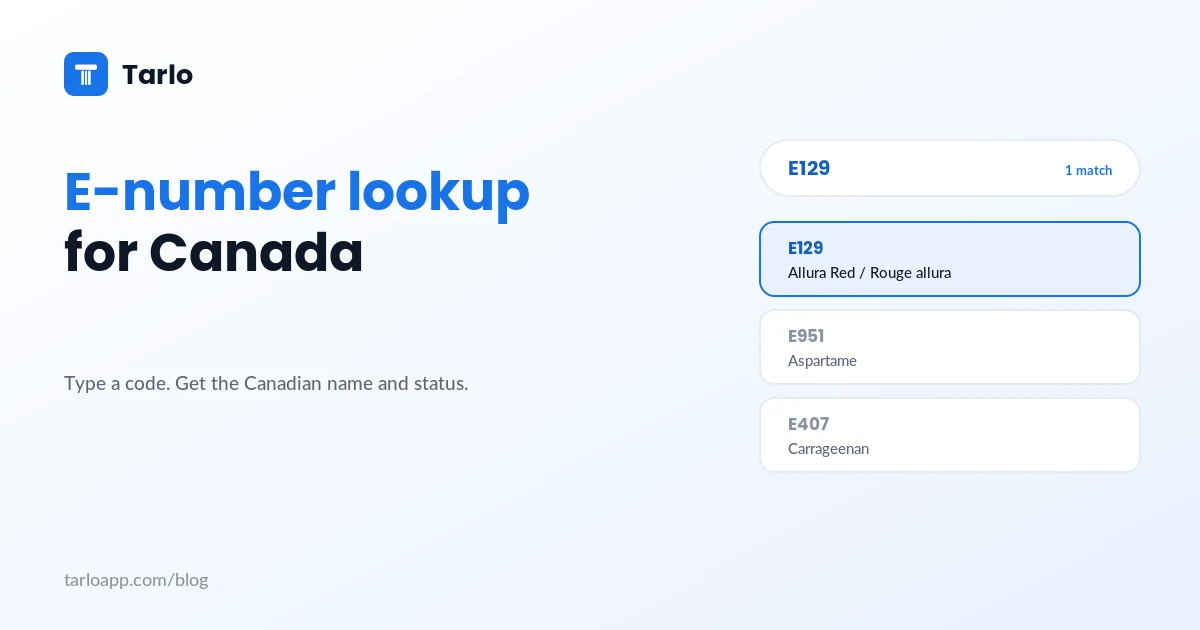
Saw “E129” or “E951” on an imported label, in a news story, or in one of our guides and want to know what it is? Type it below — this page is a searchable lookup of the E-numbers Canadian shoppers actually meet, with each additive’s Canadian label name, French name, category, and current status. Bookmark it; we keep it current as regulators move.
One habit worth knowing first: Canadian labels usually print the name (e.g., “Allura Red”), not the code — E-numbers are the international shorthand. Tarlo matches both on every scan, so a code caught anywhere in the world’s data still triggers your rules here.
| Code | Canadian label name | French | Category | Status & notes |
|---|---|---|---|---|
| E100 | Curcumin / turmeric | Curcumine | Colour (natural) | Permitted |
| E101 | Riboflavin | Riboflavine | Colour (natural) | Permitted — vitamin B2 |
| E102 | Tartrazine | Tartrazine | Colour (synthetic) | Permitted CA · US phase-out · EU child warning |
| E110 | Sunset Yellow FCF | Jaune soleil FCF | Colour (synthetic) | Permitted CA · US phase-out · EU child warning |
| E120 | Carmine / cochineal | Carmin | Colour (insect-derived) | Permitted — allergen for some; not vegetarian |
| E127 | Erythrosine (Red 3) | Érythrosine | Colour (synthetic) | Permitted CA · revoked in US |
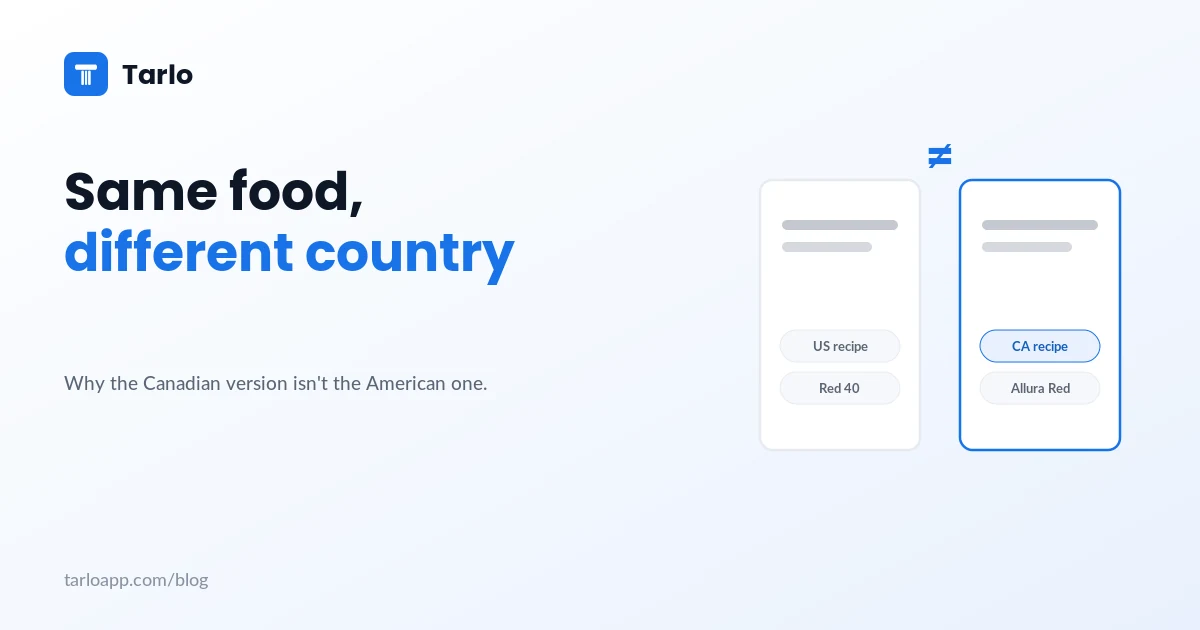
| E129 | Allura Red (Red 40) | Rouge allura | Colour (synthetic) | Permitted CA · US phase-out · EU child warning |
| E132 | Indigotine (Blue 2) | Indigotine | Colour (synthetic) | Permitted CA · US phase-out |
| E133 | Brilliant Blue FCF (Blue 1) | Bleu brillant FCF | Colour (synthetic) | Permitted CA · US phase-out |
| E143 | Fast Green FCF (Green 3) | Vert solide FCF | Colour (synthetic) | Permitted CA · not permitted EU |
| E150 | Caramel colour (I–IV) | Colorant caramel | Colour | Permitted — most-used colour worldwide |
| E160b | Annatto | Rocou / annatto | Colour (natural) | Permitted — sensitivity reported in some people |
| E171 | Titanium dioxide | Dioxyde de titane | Colour (whitener) | Permitted CA · banned EU |
| E200–202 | Sorbic acid / sorbates | Acide sorbique / sorbates | Preservative | Permitted — mould control |
| E211 | Sodium benzoate | Benzoate de sodium | Preservative | Permitted — acidic drinks, condiments |
| E220–228 | Sulphites | Sulfites | Preservative | Permitted — priority allergen, always declared |
| E249–250 | Potassium/sodium nitrite | Nitrite de potassium/sodium | Curing agent | Permitted with limits — cured meats |
| E251–252 | Sodium/potassium nitrate | Nitrate de sodium/potassium | Curing agent | Permitted with limits — slow cures |
| E300 | Ascorbic acid (vitamin C) | Acide ascorbique | Antioxidant | Permitted — also a cure accelerator |
| E306–309 | Tocopherols (vitamin E) | Tocophérols | Antioxidant | Permitted — the "natural" BHA/BHT alternative |
| E319 | TBHQ | TBHQ | Antioxidant (synthetic) | Permitted with limits — frying oils, instant noodles |
| E320 | BHA | BHA (hydroxyanisole butylé) | Antioxidant (synthetic) | Permitted CA · IARC 2B · California-listed |
| E321 | BHT | BHT (hydroxytoluène butylé) | Antioxidant (synthetic) | Permitted CA — cereals, gum |
| E322 | Lecithin | Lécithine | Emulsifier | Permitted — soy or sunflower origin |
| E330–333 | Citric acid / citrates | Acide citrique / citrates | Acidity regulator | Permitted — ubiquitous |
| E338–341 | Phosphoric acid / phosphates | Acide phosphorique / phosphates | Acidity / texture | Permitted — colas, processed cheese |
| E407 | Carrageenan | Carraghénine | Thickener (seaweed) | Permitted — infant-formula restrictions elsewhere |
| E412 | Guar gum | Gomme de guar | Thickener | Permitted |
| E415 | Xanthan gum | Gomme xanthane | Thickener | Permitted — fermentation-derived |
| E418 | Gellan gum | Gomme gellane | Thickener | Permitted — common carrageenan replacement |
| E440 | Pectin | Pectine | Gelling agent | Permitted — fruit-derived |
| E450–452 | Di/tri/polyphosphates | Polyphosphates | Texture / moisture | Permitted with limits — deli meats, seafood |
| E471 | Mono- and diglycerides | Mono- et diglycérides | Emulsifier | Permitted — baked goods, spreads |
| E500 | Sodium bicarbonate | Bicarbonate de sodium | Raising agent | Permitted — baking soda |
| E621 | Monosodium glutamate (MSG) | Glutamate monosodique | Flavour enhancer | Permitted — see our MSG guide |
| E631/E627 | Disodium inosinate/guanylate | Inosinate/guanylate disodique | Flavour enhancer | Permitted — MSG's usual partners |
| E950 | Acesulfame-potassium (Ace-K) | Acésulfame-potassium | Sweetener (artificial) | Permitted — usually blended |
| E951 | Aspartame | Aspartame | Sweetener (artificial) | Permitted — phenylalanine statement required |
| E954 | Saccharin | Saccharine | Sweetener (artificial) | Permitted (re-allowed 2014 after historic ban) |
| E955 | Sucralose | Sucralose | Sweetener (artificial) | Permitted — heat-stable |
| E960 | Steviol glycosides | Glycosides de stéviol | Sweetener (plant-derived) | Permitted |
| E961 | Neotame | Néotame | Sweetener (artificial) | Permitted — rare in Canada |
| E965–968 | Maltitol / xylitol / erythritol | Maltitol / xylitol / érythritol | Sugar alcohols | Permitted — laxative note at volume; xylitol toxic to dogs |
No match in this table — it covers the ~45 most common codes. Scan the product with Tarlo and the full additive data comes with it.
How to use E-numbers as a Canadian shopper
Three practical notes. Canadian labels print names, not codes — you’ll see “Allura Red,” not E129; the code is how the same additive is tracked internationally, and how Tarlo’s rules match additives language-independently. The code families are meaningful — E1xx colours, E2xx preservatives, E3xx antioxidants, E4xx texture, E6xx flavour enhancers, E9xx sweeteners — so even an unfamiliar code tells you the job. “Permitted” is a legal status, not a verdict — several permitted rows above are exactly the ingredients shoppers choose to avoid; deep dives: dyes, sweeteners, nitrites, BHA/BHT/TBHQ, carrageenan, MSG, titanium dioxide.
Frequently asked questions
Why don’t Canadian labels just print the E-numbers?
Canadian regulation requires common names (bilingual) so shoppers read words, not codes. The EU prints codes; Canada prints names — same additives underneath, which is why this table maps both.
An imported product lists a code not in this table — what now?
The table covers the ~45 most common; hundreds exist. Scanning the barcode in Tarlo pulls the product’s full parsed additive tags, table membership or not.
Are low E-numbers “more natural”?
No — the numbering is a catalogue, not a safety or naturalness scale. E100 (turmeric) is plant-derived and E102 (tartrazine) synthetic; neighbours in number only.
Which of these does Tarlo flag by default?
The default rules cover synthetic dyes (E102–E133 family) and glucose-fructose; presets add sweeteners (E950–E961), nitrites (E249–252) and BHA/BHT/TBHQ (E319–321) in one tap each.
Sources
- Health Canada — Lists of Permitted Food Additives: canada.ca
- CFIA — common-name and bilingual labelling requirements: inspection.canada.ca
- EU Regulation 1333/2008 — E-number classifications (for cross-reference).
Tarlo reflects the rules you turn on and is for general information only — it is not medical or dietary advice. Regulatory details are Canadian and current as of the date above; always verify the product's physical label.