Nitrites in Deli Meat: What the Science Says (Canada)
Nitrites sit in a different category from most additives on this blog: the concern isn’t a disputed animal study or a precautionary EU label — it’s a Group 1 IARC classification for processed meat itself, the same certainty tier as tobacco (though not the same risk size — more on that crucial distinction below). Here’s what nitrites actually do, what the evidence says, the “uncured” marketing trick to know, and how to shop your preference.
The fast route: Tarlo’s nitrites & nitrates rule flags them on any scan — including the natural-cure workarounds. Details below.
What nitrites do in cured meat
Sodium nitrite (E250) and its relatives (potassium nitrite E249, sodium/potassium nitrate E251/E252) are the curing agents behind bacon, ham, salami, hot dogs and most deli meat. They do three jobs, one of which is genuinely important: they block Clostridium botulinum — the botulism bacterium — which is why regulators everywhere still permit them; they fix the pink colour (uncured cooked pork is grey); and they create the characteristic cured flavour.
The tension in one sentence: the additive that protects against a deadly acute risk (botulism) is also implicated in a long-term one.
The IARC classification, explained
In 2015, the WHO’s cancer agency IARC classified processed meat as Group 1 — carcinogenic to humans — based on evidence linking consumption to colorectal cancer. The proposed mechanism runs through nitrites: in the meat and in your gut, they can form N-nitroso compounds (nitrosamines), which damage DNA. (Red meat separately got Group 2A, “probably carcinogenic.”)
Two clarifications the headlines mangled:
- Group 1 describes evidence certainty, not risk size. Tobacco and processed meat share the tier because the evidence is similarly convincing — not because a slice of ham equals a cigarette.
- The classification is for processed meat as a category (curing, smoking, salting), with nitrosamines as a leading suspected pathway — not a verdict on nitrite molecules in isolation. Vegetables are actually the biggest dietary nitrate source, but they arrive with vitamin C and without protein-dense, high-heat conditions, so they don’t behave the same way.
How big is the risk, actually
IARC’s working figure: each 50 g of processed meat daily (roughly two slices of bacon) is associated with about an 18% relative increase in colorectal cancer risk. Lifetime baseline risk in Canada is roughly 6–7%, so daily consumption moves it to around 7–8% absolute. Meaningful across a population; for an individual, a shift measured in single percentage points — for daily eaters.
That’s the honest frame: not “ham is the new smoking,” not “nothing to see here.” Health Canada and the Canadian Cancer Society translate it as limit processed meat — and how far to take that is a personal rule if anything is.
The “uncured” label trick
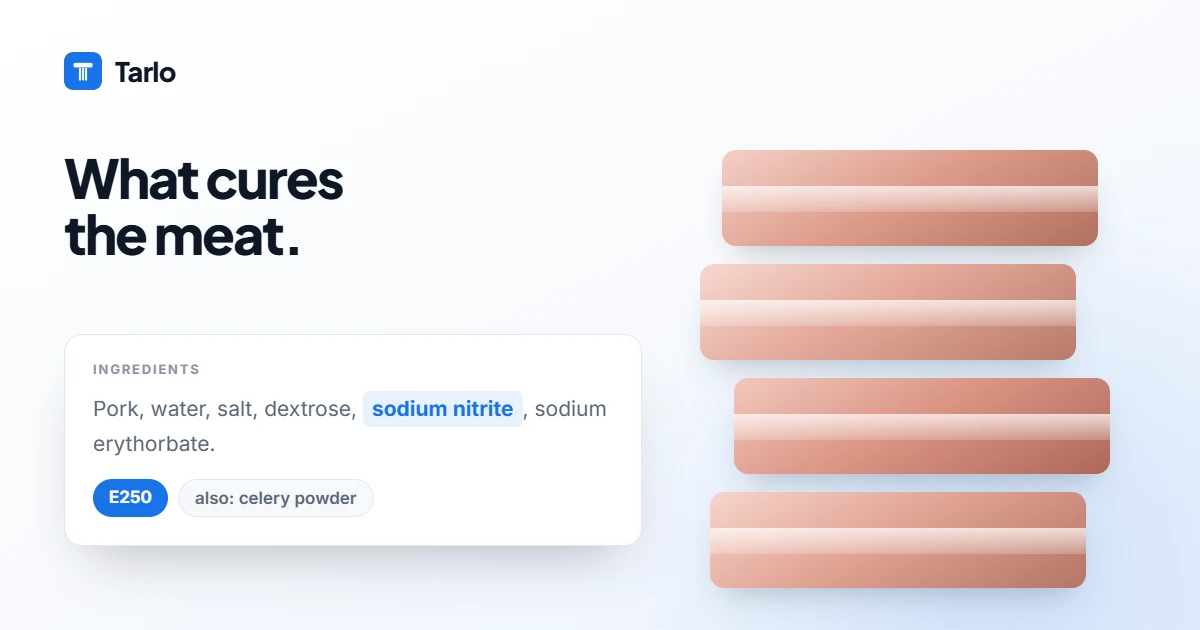
The marketing evolution to know: products labelled “uncured,” “no nitrites added,” or “naturally cured” are usually cured with celery extract or celery salt — which is naturally rich in nitrate that converts to nitrite during curing. Chemically, the finished product can contain as much or more nitrite than conventionally cured meat. US rules force the fine print “except those naturally occurring in celery powder”; Canadian labels list “cultured celery extract” as an ingredient.
If your rule is about the chemistry, celery-cured products don’t satisfy it. If your rule is about synthetic additives specifically, they might. Decide which rule you’re actually enforcing — and note Tarlo’s nitrites rule catches the celery-cure terms too, precisely because of this ambiguity.
What to look for on Canadian labels
| Label term (EN) | French | What it is |
|---|---|---|
| Sodium nitrite | Nitrite de sodium | The standard cure (E250) |
| Sodium/potassium nitrate | Nitrate de sodium/potassium | Slow-cure form (E251/E252) |
| Cultured celery extract / celery salt | Extrait de céleri | The “natural” cure — still delivers nitrite |
| Ascorbate / erythorbate | Ascorbate / érythorbate | Cure accelerators — also reduce nitrosamine formation |
That last row is worth knowing: vitamin-C-family additives in cured meat are there partly to suppress nitrosamine formation — an additive working for you.
How to shop your preference
Practical tiers, depending on how far you want to go: frequency first (the evidence scales with daily habits, not occasional consumption); genuinely uncured options — fresh-cooked meats (roast chicken or pork you cook, or store-roasted) rather than “uncured”-labelled deli; and checking the specific product — nitrite levels and formulations vary. Our nitrite-free deli guide covers what’s realistically available in Canadian stores.
In Tarlo, the nitrites & nitrates preset checks additive codes (E249–E252) plus the bilingual text including celery-cure terms, and shows same-shelf alternatives that pass. Deli products are also frequent sodium-symbol carriers, so the two rules together give the full picture on that aisle.
Frequently asked questions
Is the nitrate in vegetables the same concern?
The molecules are related, but the context differs: vegetable nitrate arrives with vitamin C and polyphenols that inhibit nitrosamine formation, and without high-heat protein curing. No health body advises avoiding vegetables over nitrate.
Is bacon with “no added nitrites” safer?
Chemically it’s usually equivalent (celery-cured). Choose it for ingredient-philosophy reasons if you like, but don’t pay a premium believing the nitrite is gone.
Why not just ban nitrites?
Botulism. Regulators judge the acute risk of uncured, improperly handled meat as worse than the managed long-term risk — with limits on how much nitrite can be used and requirements for cure accelerators.
Does cooking method matter?
High heat matters: charring or frying cured meat hard (crispy bacon) increases nitrosamine formation versus gentler cooking. One of the few levers you control after purchase.
Sources
- IARC Monographs vol. 114 (2015) — processed meat classification: iarc.who.int
- Health Canada — permitted preservatives (nitrites/nitrates) and limits: canada.ca
- Canadian Cancer Society — processed meat guidance.
Tarlo reflects the rules you turn on and is for general information only — it is not medical or dietary advice. Regulatory details are Canadian and current as of the date above; always verify the product's physical label.