BHA, BHT & TBHQ: The Preservatives Under Scrutiny
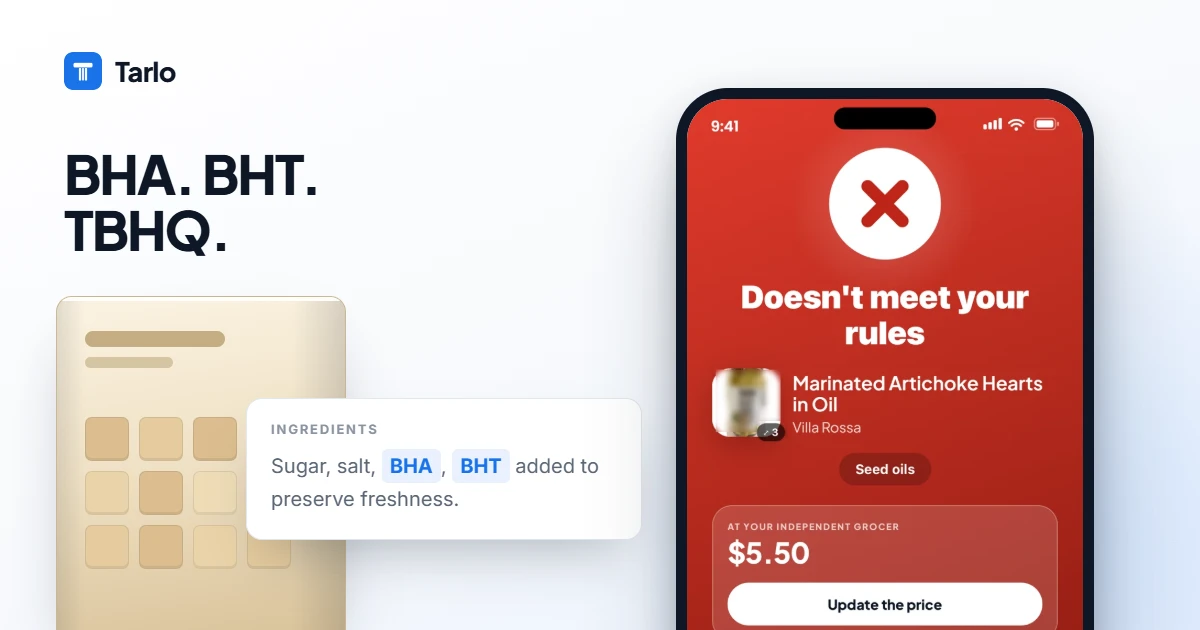
BHA, BHT and TBHQ are the three synthetic antioxidants that keep fats in processed food from going rancid — and three of the most commonly targeted ingredients among label-conscious shoppers. One of them (BHA) is listed as a possible carcinogen by IARC and as a known one by California, while Health Canada permits all three. Here’s what they do, what the disagreement is actually about, and where they hide (including one spot that isn’t even in the ingredient list).
Want them flagged without the reading? Tarlo’s BHA/BHT/TBHQ rule checks every scan, both languages, free.
What they do
All three are synthetic antioxidants: they slow the oxidation of fats and oils, which is what makes chips stale-tasting, cereal cardboard-flavoured and shortening rancid. They extend shelf life measurably and cheaply — a genuinely functional job, unlike a cosmetic dye or whitener. The question has never been whether they work; it’s whether the trade-off is one you want.
Telling the three apart
| Label name | Code | Notes | |
|---|---|---|---|
| BHA | Butylated hydroxyanisole / BHA | E320 | The most scrutinized — IARC Group 2B |
| BHT | Butylated hydroxytoluene / BHT | E321 | Mixed animal evidence; most-used of the three |
| TBHQ | Tertiary butylhydroquinone / TBHQ | E319 | Common in frying oils and instant noodles |
Canadian labels may use the full chemical name or the acronym (codes decoded in the E-number lookup), in English and French (hydroxyanisole butylé, hydroxytoluène butylé). They often appear together or with citric acid as a synergist.
Where they hide
The fat-heavy, long-shelf-life aisles: breakfast cereals (sprayed on the grain or the packaging), crackers and instant noodles (TBHQ especially, via the frying oil), shortening and lard, dehydrated potato products, chewing gum (BHT’s classic home), snack seasonings, some dried meats, and — outside food — lipsticks and moisturizers. They’re also common in pet food.
Their profile has been shrinking for years: many major cereal and snack brands reformulated toward vitamin E (tocopherols) or rosemary extract under consumer pressure. But “shrinking” is doing a lot of work — TBHQ in particular remains widespread in fried and instant products.
What the science debate is about
BHA carries the strongest flag: high-dose studies in rodents produced forestomach tumours, earning it IARC Group 2B (“possibly carcinogenic”) and a listing under California’s Proposition 65. The counterargument regulators accept: humans don’t have forestomachs, the doses were enormous, and human-relevant evidence is weak. Health Canada, the US FDA and EFSA all permit BHA at limited levels.
BHT has messier evidence — some animal studies suggest tumour promotion, others suggest protection (it’s an antioxidant, after all). No major regulator restricts it beyond use limits.
TBHQ drew newer attention from immune-system studies in animals and its ubiquity in ultra-processed food; the EU and others reaffirmed its ADI (0.7 mg/kg). At very high doses it’s genuinely toxic — and at permitted levels regulators consider margins ample.
The familiar pattern from our titanium dioxide guide: same data, different institutional risk tolerance. California lists; Ottawa permits. The products they’re in — heavily processed, fat-dense — are often ones shoppers limit anyway, so the practical cost of a “no BHA/BHT/TBHQ” rule is low.
The packaging loophole
One quirk worth knowing: BHT is sometimes applied to the packaging liner (the wax bag inside a cereal box) rather than the food, to migrate slowly and protect the contents. Depending on jurisdiction and use, that may not appear in the ingredient list. It’s a small exposure — but it explains why a “clean-label” cereal can still smell faintly of preservative, and it’s a genuine limit on what any label-reader (human or app) can see. Tarlo checks declared ingredients; nobody can scan an undeclared liner.
How to avoid them
In Tarlo, the BHA/BHT/TBHQ preset checks pre-parsed additive codes (E319–E321) and the bilingual ingredient text on every scan, with same-shelf alternatives when a product fails. Manual shortcuts if you’re reading labels: tocopherols (“vitamin E”) and rosemary extract in the ingredient list are the usual replacements — their presence usually means the synthetics are absent.
Frequently asked questions
Are BHA and BHT banned anywhere?
Not banned in major markets for general food use, though Japan and parts of the EU restrict specific applications. California requires Prop 65 notice for BHA in some contexts. Canada permits all three with limits.
Is TBHQ “lighter fluid”?
A viral half-truth: TBHQ is chemically related to butane-family compounds but is not lighter fluid, and dose determines everything. The accurate criticism is ubiquity in ultra-processed food, not a lighter-fluid gotcha.
Do “natural” antioxidants work as well?
Mostly — tocopherols and rosemary extract protect fats well, at somewhat higher cost and sometimes shorter shelf life. That cost difference is the entire reason the synthetics persist.
Which rule should I use if I just want less of all this?
The BHA/BHT/TBHQ preset covers the trio. Shoppers who use it usually pair it with the dyes and HFCS rules — the classic ultra-processing trio in one pass.
Sources
- Health Canada — permitted preservatives (Class IV, antioxidants): canada.ca
- IARC Monographs — BHA (Group 2B).
- EFSA — re-evaluations of BHA (E320), BHT (E321), TBHQ (E319).
Tarlo reflects the rules you turn on and is for general information only — it is not medical or dietary advice. Regulatory details are Canadian and current as of the date above; always verify the product's physical label.