Titanium Dioxide in Food: Banned in the EU, Legal in Canada
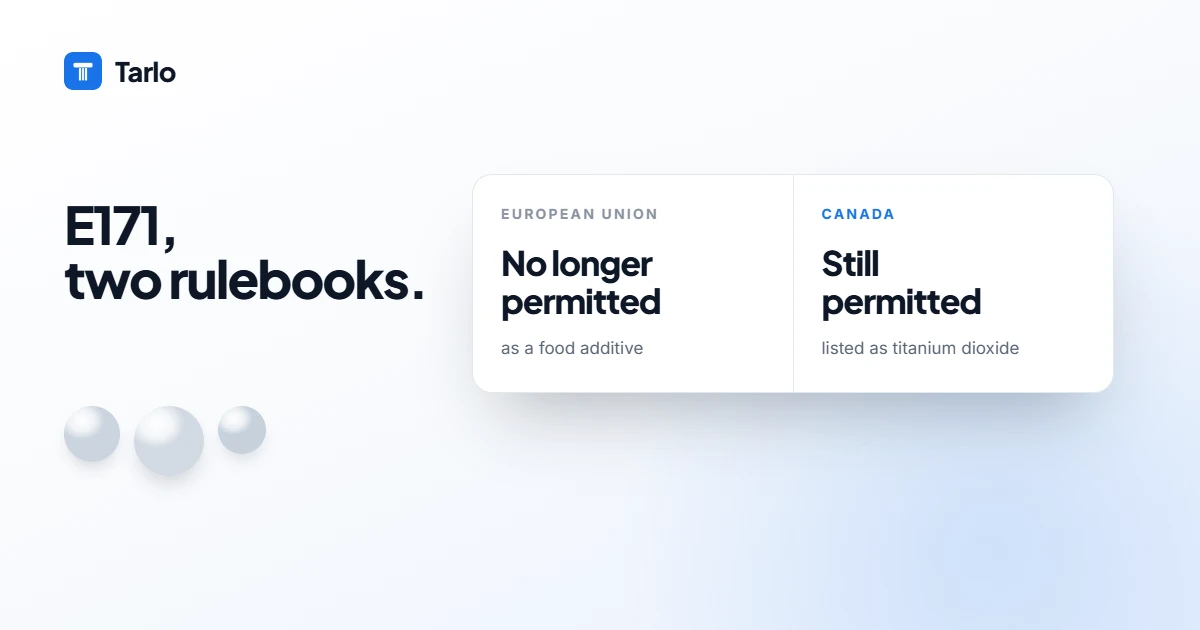
Titanium dioxide is the rare additive where two respected regulators looked at the same evidence and reached opposite conclusions: the European Union banned it from food in 2022, while Health Canada reviewed the same science and kept it on the permitted list — a position it still holds in 2026. If you’ve seen “E171 banned in Europe!” posts and wondered what that means for your Canadian cart, this is the full picture.
Want it flagged regardless of the debate? Add it as a rule in Tarlo and every scan checks for it automatically.
What titanium dioxide does in food
Titanium dioxide (E171) is a white pigment — the same base compound used in paint, sunscreen and toothpaste, food-grade in this case. In food it does one job: makes things opaque, bright white, or gives colours a vivid base coat. It has no flavour, no nutritional role, and no preservative function. It is, in the most literal sense, cosmetic.
That matters to the debate: when an additive is purely cosmetic, the bar for “why risk any uncertainty?” sits lower for many shoppers than it would for, say, a preservative that prevents spoilage.
Where it shows up
In Canada you’ll find it in candy-coated chocolates and gum, white icings and decorations, marshmallows, some coffee whiteners, powdered doughnut coatings, hard-shell candies, and some sauces and dressings — plus many pills and supplements (a separate regulatory lane). On Canadian labels it appears as “titanium dioxide” (English) or “dioxyde de titane” (French); the E-number E171 rarely appears on North American packaging.
Since the EU ban, many multinational brands have quietly reformulated globally — rice starch and calcium phosphate are common substitutes — so its presence in Canada is shrinking even without a Canadian rule change. But it has not disappeared; the only way to know for a given product is the ingredient list.
Why the EU banned it
In 2021 the European Food Safety Authority (EFSA) reviewed titanium dioxide and concluded it could “no longer be considered safe as a food additive” — the pivotal issue was genotoxicity: EFSA couldn’t rule out that accumulated nanoparticles might damage DNA. Under Europe’s precautionary approach, “can’t rule it out” plus “purely cosmetic benefit” equalled removal; the ban took force in 2022.
Why Canada didn’t
Health Canada’s Food Directorate conducted its own state-of-the-science review (published 2022, maintained since) and reached a different verdict: the studies driving EFSA’s concern used forms of titanium dioxide or exposure routes not representative of food-grade E171 in real diets, and the weight of evidence didn’t demonstrate a health risk at dietary exposure levels. The UK and Australia/New Zealand reviewed it too and landed with Canada, not the EU.
So the honest scoreboard: EU banned; Canada, UK, Australia/NZ and the US all permit. Nobody in that list is careless — they weigh uncertainty differently.
How to read the disagreement
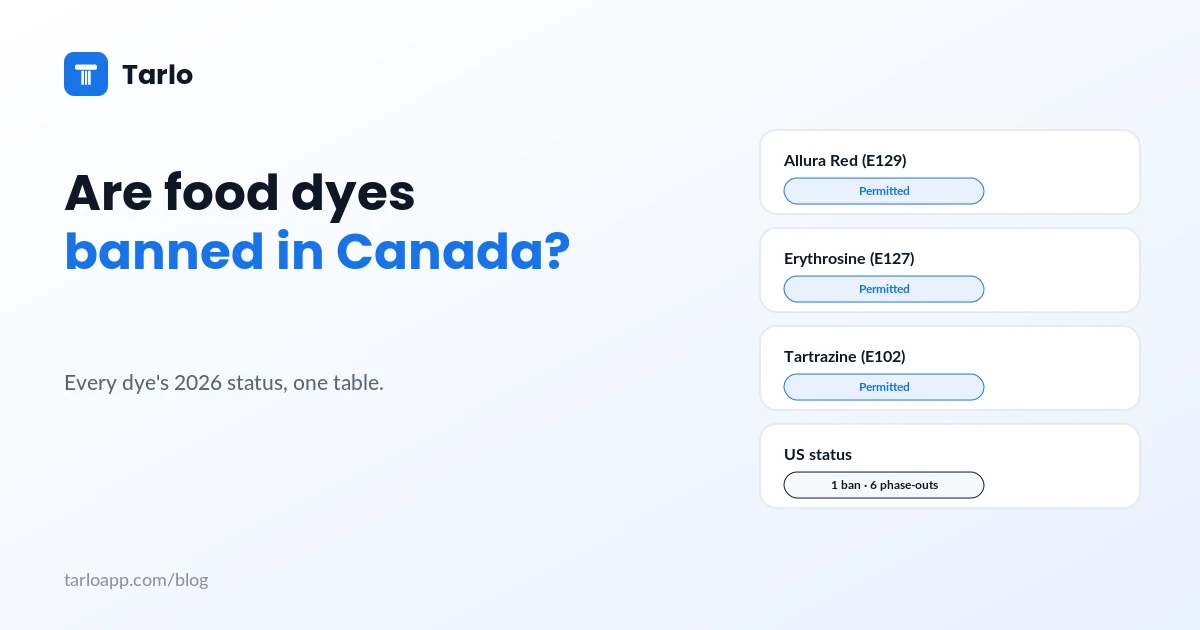
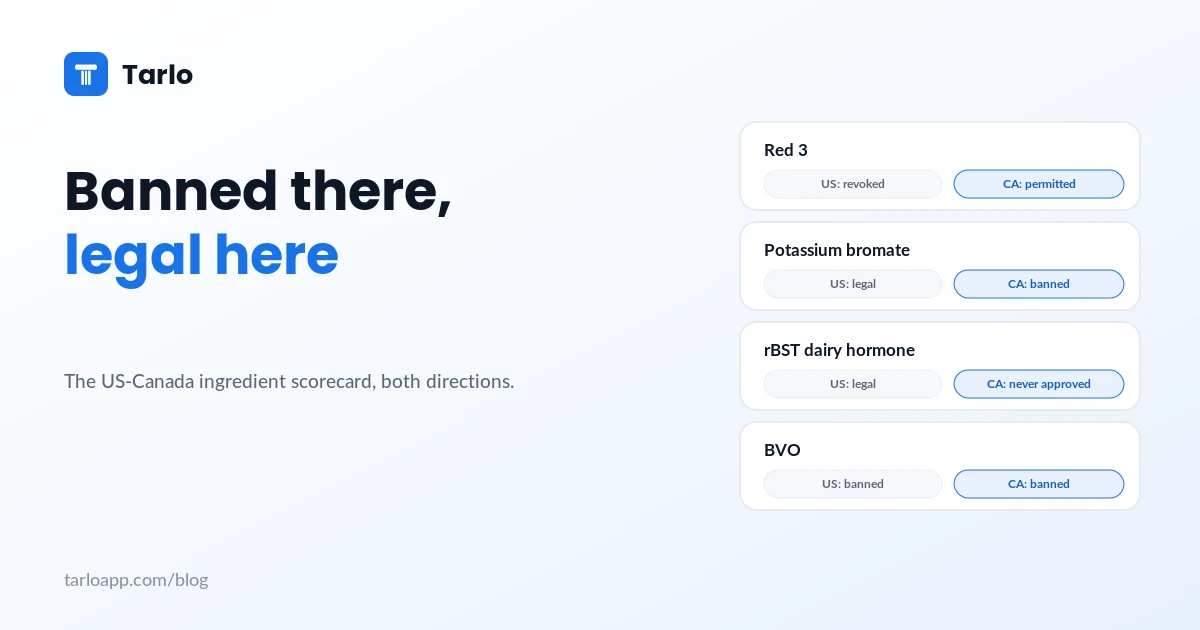
This split is the clearest example of a pattern that runs through many additives (Allura Red’s EU warning label is another): regulators using the same evidence can diverge (the whole US-Canada scorecard) because they apply different standards for how much uncertainty is acceptable — especially for ingredients with zero functional benefit to the eater.
Which reading you adopt is legitimately personal. “Health Canada reviewed it and I trust that” is reasonable. “It’s cosmetic, the EU banned it, why take any question mark?” is also reasonable. This is precisely the kind of call Tarlo refuses to make for you — it states the fact, you set the rule.
How to avoid it in Canada
Reading every candy and icing label for “titanium dioxide / dioxyde de titane” is doable but slow — it clusters in exactly the aisles with the longest ingredient lists. In Tarlo, add it to your rules once; every scan then checks the pre-parsed additive codes (E171) and the bilingual ingredient text, and a fail comes with alternatives from the same shelf that pass — many “naturally coloured” candy lines already skip it.
Note it often travels with synthetic dyes: the white base coat is what makes candy colours pop. Shoppers avoiding one frequently avoid both, and the dyes rule plus an E171 watch covers the pair.
Frequently asked questions
Is titanium dioxide banned in the US?
No. The FDA permits it (within limits), though it faces state-level legislative pressure and petitions. California’s additive law targeted other additives, not E171.
Does “banned in Europe” mean products here contain something illegal?
No — it means the same product may be formulated differently for different markets. A European version of a candy may use rice starch where the Canadian version uses titanium dioxide. Both are legal where sold.
Is the titanium dioxide in sunscreen the same issue?
Different exposure route entirely. The food debate concerns ingested nanoparticles; sunscreen sits on skin. Regulators evaluate them separately, and this article covers food only.
Will it disappear from Canadian shelves anyway?
Trend says shrinking: global brands reformulate once for all markets. But “shrinking” isn’t “gone” — scan or check the list if it’s on your avoid list.
Sources
- Health Canada — Titanium dioxide (TiO2) as a food additive: current science report: canada.ca
- EFSA (2021) — safety assessment of titanium dioxide (E171); EU Regulation removing E171 (2022).
- McGill Office for Science and Society — Titanium dioxide in food: Europe vs Canada.
Tarlo reflects the rules you turn on and is for general information only — it is not medical or dietary advice. Regulatory details are Canadian and current as of the date above; always verify the product's physical label.