Is Carrageenan Bad for You? Thickener Facts for Canada
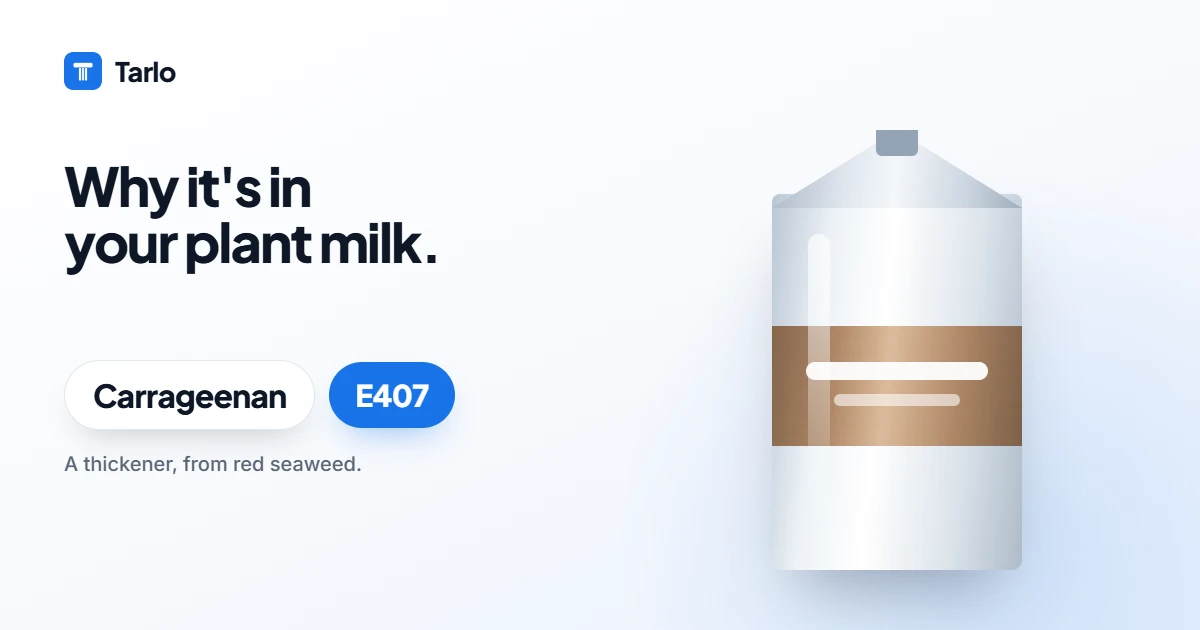
Carrageenan is the additive that launched a thousand almond-milk reformulations. Extracted from red seaweed and used to thicken and stabilize, it’s simultaneously one of the most “natural” additives on the label and one of the most argued-about. The argument, it turns out, hinges on a distinction most viral posts skip entirely. Here it is properly.
If you’d rather just filter it out: add carrageenan to your rules in Tarlo and every scan checks for it — details below.
What carrageenan is
Carrageenan is a family of polysaccharides extracted from red seaweed (Irish moss and relatives — coastal communities have cooked with it for centuries). In modern food manufacturing it’s a thickener, gelling agent and stabilizer: it keeps cocoa suspended in chocolate milk, stops plant-based milks from separating, gives dairy-free ice cream its body, and holds moisture in sliced deli meats.
On Canadian labels it appears as “carrageenan” (English) or “carraghénine” (French) — E407 internationally.
Where it shows up
The heaviest users: plant-based milks (almond, soy, oat, coconut), chocolate milk and cream, dairy-free frozen desserts, whipping cream and aerosol creams, cottage cheese and some yogurts, deli meats (moisture retention), and canned pet food (where much of the tonnage actually goes). It’s especially relevant to plant-based shoppers — the category where it’s most common and where the backlash hit hardest.
The degraded vs food-grade distinction
This is the part that decides the whole debate, and it’s routinely blurred:
- Food-grade (undegraded) carrageenan — the additive actually permitted in food. Large molecules, largely not absorbed, used for texture.
- Degraded carrageenan (poligeenan) — a chemically broken-down version produced with hot acid. It is not permitted in food and never has been. Poligeenan reliably causes gut inflammation in lab animals — that’s why researchers use it deliberately to induce colitis in studies.
Most alarming claims about carrageenan cite research on poligeenan or on cell cultures exposed in ways that don’t mirror digestion. The legitimate open question is narrower: whether some degradation can occur in the acidic stomach, and whether food-grade carrageenan affects sensitive guts at real intakes. Some small studies and patient anecdotes (notably around IBD) say maybe; larger reviews haven’t confirmed it.
What regulators say
Health Canada permits carrageenan as a food additive. JECFA re-reviewed it in 2014 and set an ADI of “not specified” — its least-concerned category — for food-grade material, though it recommended against use in infant formula as a precaution, and the EU restricts it in formula while permitting it generally. The US FDA permits it, having rejected petitions for removal.
So the regulatory picture: permitted everywhere for general food, with extra caution applied only to infant formula.
Why many brands dropped it anyway
Through the 2010s, consumer campaigns pushed carrageenan onto “avoid” lists, and brands did the math: the additive is replaceable (gellan gum, locust bean gum, sunflower lecithin do similar jobs), and “carrageenan-free” became a selling point. Many major almond-milk and yogurt lines reformulated — not because a regulator required it, but because shoppers voted.
That history cuts both ways for you as a shopper: plenty of carrageenan-free options exist in every category it inhabits, so avoiding it costs almost nothing — and the products that still use it are relying on a genuinely permitted, seaweed-derived additive. Either choice is defensible. Your rule, your call.
How to avoid it
People who avoid it usually cite a sensitive gut (some with IBD report improvement off it — anecdotal but persistent), a general preference for shorter ingredient lists, or precaution while research continues.
Practically: it clusters in categories where labels are short, so manual checking is feasible — but scanning is faster across a cart. In Tarlo, add carrageenan to your rules; scans check the bilingual ingredient text and E407 code, and fails come with same-shelf alternatives (the carrageenan-free reformulations make these easy to find). If you’re in the plant-based aisle anyway, the seed-oils rule often interests the same shoppers.
Frequently asked questions
Is carrageenan vegan?
Yes — it’s seaweed-derived, which is exactly why plant-based products use it instead of gelatin (animal-derived). Avoiding carrageenan and needing vegan gelling agents are compatible: gellan gum and agar are both.
Is carrageenan the same as poligeenan?
No — and this is the crux. Poligeenan (degraded carrageenan) is not a food additive and is genuinely harmful in studies; food-grade carrageenan is the permitted ingredient. Claims that conflate them are the most common error in this debate.
Why is it restricted in infant formula but allowed elsewhere?
Precaution for the most vulnerable consumers with the least varied diet — a standard regulatory pattern, not evidence of general harm at adult intakes.
What replaces it in “carrageenan-free” products?
Usually gellan gum, guar gum, locust bean gum or lecithin. Whether those fit your rules is your call too — an ingredient swap isn’t automatically an upgrade.
Sources
- Health Canada — permitted food additives (emulsifying, gelling, stabilizing agents): canada.ca
- JECFA (2014) — carrageenan evaluation; ADI “not specified”; infant-formula caution.
- McKim et al. (2019), Critical Reviews in Toxicology — review distinguishing food-grade carrageenan from poligeenan.
Tarlo reflects the rules you turn on and is for general information only — it is not medical or dietary advice. Regulatory details are Canadian and current as of the date above; always verify the product's physical label.