Is Canola Oil Bad for You? Canada's Own Oil, Examined
No oil generates more heated search traffic than canola — and no country has more skin in the game than Canada, which literally invented it (the name is a contraction of Canada and ola). It’s simultaneously the oil health authorities recommend swapping butter for, and the first name on every “avoid seed oils” list. Both camps are looking at the same bottle. Here’s the full story: where canola came from, what each side’s actual argument is, and how to shop whichever conclusion you reach.
Already decided? Tarlo’s seed oils rule flags canola — including inside generic “vegetable oil” phrasing — on every scan.
The Canadian invention
In the 1970s, plant breeders at the University of Manitoba and Agriculture Canada bred a new variety of rapeseed with two traits: very low erucic acid (a fatty acid with heart-toxicity concerns in older rapeseed) and low glucosinolates (bitter compounds). The result was trademarked Canola in 1978. Today it’s one of Canada’s largest crops — prairie fields of yellow bloom — and the default oil in a huge share of Canadian packaged food, restaurant fryers and home kitchens. Whatever you conclude below, canola is the Canadian oil, which is why this question matters more here than anywhere.
The erucic acid history
Worth clearing up because old scares still circulate: pre-1970s rapeseed oil was high in erucic acid, which caused heart lesions in animal studies — that’s the origin of “rapeseed oil is toxic” claims. Canola was bred specifically to remove that problem: regulations cap erucic acid at 2% (typical canola runs well under 1%). Modern food-grade “rapeseed oil” in Europe is the same low-erucic type. Articles citing erucic-acid toxicity against modern canola are recycling a solved 50-year-old issue.
The case for canola
The mainstream nutritional argument is strong on its own terms: canola is low in saturated fat (~7%, among the lowest of any oil), high in monounsaturated fat, and one of the few common oils with meaningful omega-3 ALA. Randomized trials replacing butter/animal fats with canola consistently improve LDL cholesterol; Health Canada and heart-health organizations worldwide recommend exactly that swap. If your framework is “the fatty-acid profile is what matters,” canola scores near the top — better than olive oil on omega-3, close on monounsaturates, at a third of the price.
The case against
The avoid-canola camp doesn’t primarily dispute those numbers; it disputes the framework, on three grounds: processing — commodity canola is extracted with hexane, refined, bleached and deodorized at high heat, which critics argue creates trace oxidation products and strips minor nutrients (cold-pressed canola exists but is rare and pricey); omega-6 load and ubiquity — canola is a major contributor to the modern omega-6-heavy diet, and it arrives overwhelmingly via ultra-processed food, so heavy canola intake usually rides along with a dietary pattern people want to cut anyway; and repeated-heating concerns in commercial fryers.
Where the evidence honestly stands: trials on canola itself keep showing neutral-to-positive cardiovascular markers, and claims of unique toxicity aren’t well supported. But “I’d rather get fats from olive oil, butter or whole foods and eat less processed food” is a coherent preference no one needs to win a journal debate to hold. This is precisely the kind of call Tarlo leaves to you — the wider context is in our seed oils on Canadian labels guide.
Reading it on Canadian labels
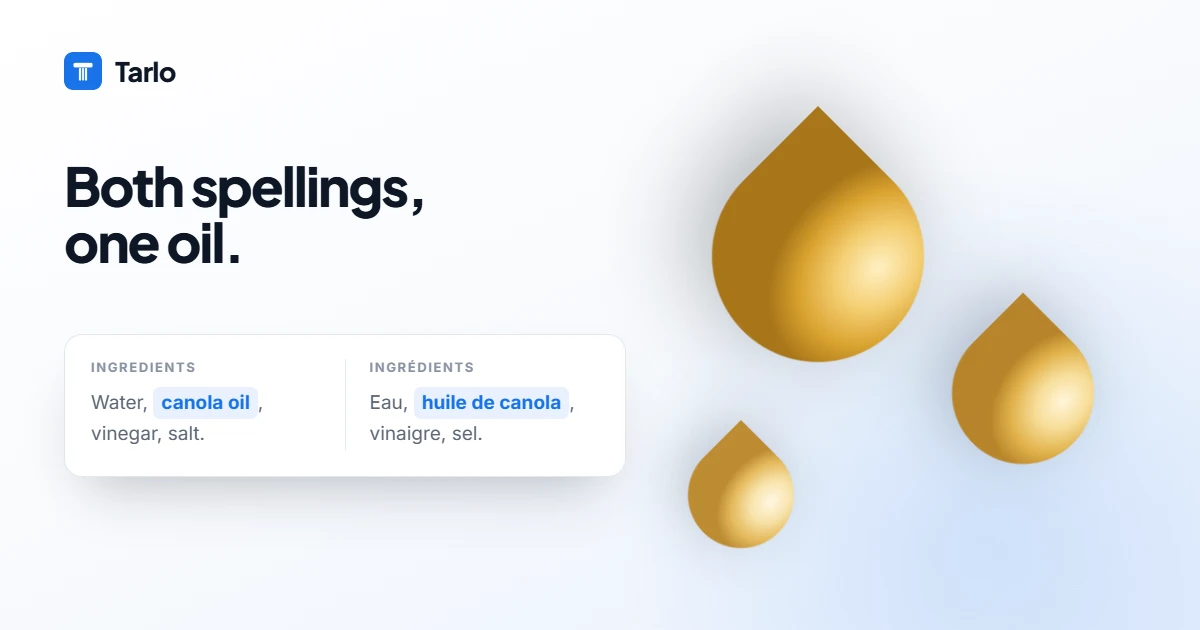
Canola’s label camouflage is the practical problem: it appears as “canola oil” / “huile de canola” when named, but very often hides inside “vegetable oil” or “vegetable oil (canola and/or soybean)” — the and/or blend that can change batch to batch. In restaurant and food-service contexts, “vegetable oil” is canola more often than not in Canada, for simple supply reasons. If you’re avoiding it by eye, you’re really scanning for four-plus phrasings in two languages.
How to avoid it if you choose
Switch on the seed oils rule in Tarlo: every scan checks for canola by name and the generic vegetable-oil phrasings, in English and French, and shows meets / doesn’t meet your rules with same-shelf alternatives — olive-oil and avocado-oil versions exist in most snack categories now, and the price gap is visible up front via shopper-reported prices. If your concern is narrower (only frying oils, or only ultra-processed carriers), a custom rule can be that narrow too.
Frequently asked questions
Is canola oil the same as rapeseed oil?
Modern food-grade rapeseed oil in Europe is essentially canola (low-erucic). Old high-erucic rapeseed — the one from the scare stories — hasn’t been food-grade for decades.
Is cold-pressed canola different?
Meaningfully, yes: no hexane, minimal heat, more minor nutrients retained — it answers most of the processing critique. It’s also several times the price and rare in packaged goods; the canola in your crackers is the refined kind.
Is canola GMO?
Most Canadian canola is genetically modified for herbicide tolerance. GM safety is its own (separately regulated) topic; non-GMO and organic canola exist for shoppers who care about that axis too.
What’s the best replacement if I avoid it?
Depends on the job: olive oil for most cooking, avocado for high heat, butter/ghee if you’re unbothered by saturated fat. In packaged goods you don’t choose the oil — you choose the product, which is what scanning for the seed-oils rule is for.
Sources
- Canola Council of Canada — history, breeding, composition.
- Health Canada — dietary fats guidance: canada.ca
- Lin et al. (2013), Nutrition Reviews — evidence review of canola oil and health outcomes.
Tarlo reflects the rules you turn on and is for general information only — it is not medical or dietary advice. Regulatory details are Canadian and current as of the date above; always verify the product's physical label.