Tarlo vs Fig: Allergies, Diets and Your Own Rules
This is the comparison where we’ll say something rare in a “vs” post: for a meaningful group of shoppers, the other app is the right choice. Fig is the field’s best tool for allergies, intolerances and medical diets. Tarlo is a Canada-first rules engine with swaps and shelf prices. They overlap less than any two apps we’ve compared — which makes choosing (or combining) unusually easy once you see the split.
Try Tarlo free either way; the honest breakdown follows.
At a glance
| Tarlo | Fig | |
|---|---|---|
| Core job | Your avoid-rules + Canadian thresholds | Diet & allergy compatibility |
| Depth on allergies/diets | Presets + custom rules | Deep: celiac, FODMAP, dozens of conditions, family profiles |
| Built for | Canada (EN/FR labels, Health Canada FOP) | Broad, US-leaning |
| Nutrient rules | Health Canada per reference amount | Not FOP-based |
| Swaps | Same-shelf, pass-your-rules | Product discovery/search |
| Shelf prices | Yes — shopper-reported | No |
| Price | Free | Free + premium |
Where Fig genuinely wins
If a wrong purchase means someone in your house gets sick, Fig deserves the download. Its condition templates go far beyond ingredient keywords: celiac handling with cross-contamination awareness, low-FODMAP (a genuinely complex diet no keyword list captures), dozens of allergen and intolerance profiles, and multiple family member profiles checked simultaneously — scan once, see whether a product clears Mom’s celiac, one kid’s dairy allergy and another’s FODMAP list together. Its product-discovery search (“show me compliant crackers”) is strong too.
That’s specialist tooling built over years for a hard problem, and we’re not going to pretend rule toggles replicate it. For medical-grade dietary filtering, Fig is the benchmark.
Where Tarlo is different
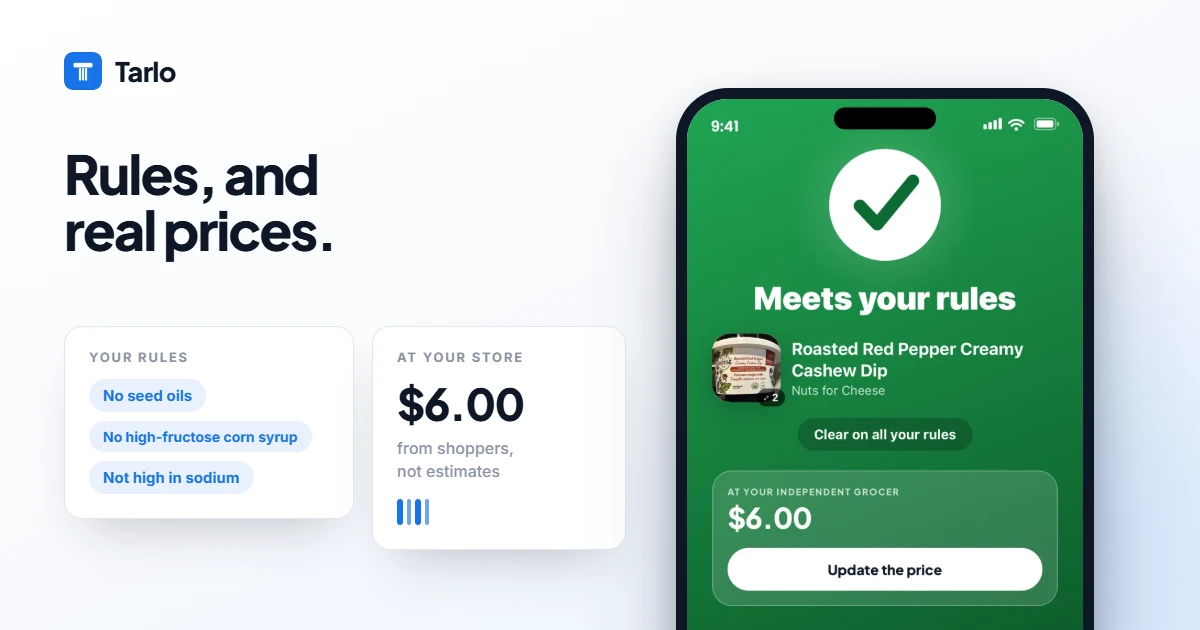
Tarlo’s territory is everything outside the medical lane: the avoid-by-choice rules — dyes, glucose-fructose, seed oils, sweeteners, nitrites, BHA/BHT — plus the two things no allergy app attempts: Health Canada’s high-in thresholds computed per reference amount, and the shopping economics — same-shelf swaps that pass your rules, with shopper-reported prices before the till. Add bilingual EN/FR label matching and the Canada-first catalog, and Tarlo is simply pointed at a different job: not “is this safe for my condition,” but “does this meet my standards, and what should I grab instead, for how much.”
The safety vs preference distinction
Worth stating plainly, because it’s the real dividing line: allergy filtering is a safety function; rule filtering is a preference function. Tarlo’s word-list matching is built for preferences — it’s deterministic and bilingual, but it doesn’t model cross-contamination, facility warnings or “may contain” nuance the way a dedicated allergy tool does, and we won’t market it as if it did. If anaphylaxis or celiac is in the picture, use a purpose-built tool (Fig or equivalent) and read the physical label — every time, no app substitutes.
Using both
The rare combo that makes complete sense: Fig for the family member with the medical need; Tarlo for the household’s rules and wallet. They don’t conflict — one answers “is this compatible with her condition,” the other answers “does this meet our standards and what does it cost here.” Several of our own testers run exactly this pair.
If you need neither the medical depth nor the prices, the broader field — Yuka’s score, Bobby Approved’s fixed list — is compared in best food scanner app in Canada.
Frequently asked questions
Can Tarlo handle my dairy allergy?
You can build a custom rule for milk-ingredient terms, and it will catch declared ingredients in both languages. But for a medical allergy, that’s not enough — precautionary “may contain” statements and cross-contamination are exactly where keyword rules fall short. Use a dedicated tool and the physical label.
Does Fig work in Canada?
It’s available and scans Canadian barcodes; its catalog and label handling lean US, so expect more misses on Canadian store brands and French-side text — the same gap we document for Yuka in Canada.
Which app is free?
Tarlo is free. Fig has a free tier with premium features (multiple profiles, some diets) behind a subscription.
I just want gluten-free-ish shopping, not celiac-grade. Which app?
That’s preference territory — a Tarlo custom rule for gluten grains works and adds swaps + prices. Celiac-grade certainty is Fig-and-label territory.
Sources
- Fig — public app listing and feature pages, reviewed August 2026.
- Health Canada — allergen labelling and front-of-package rules: canada.ca
Tarlo reflects the rules you turn on and is for general information only — it is not medical or dietary advice. Regulatory details are Canadian and current as of the date above; always verify the product's physical label.