
Shrinkflation in Canada: How to Actually Catch It
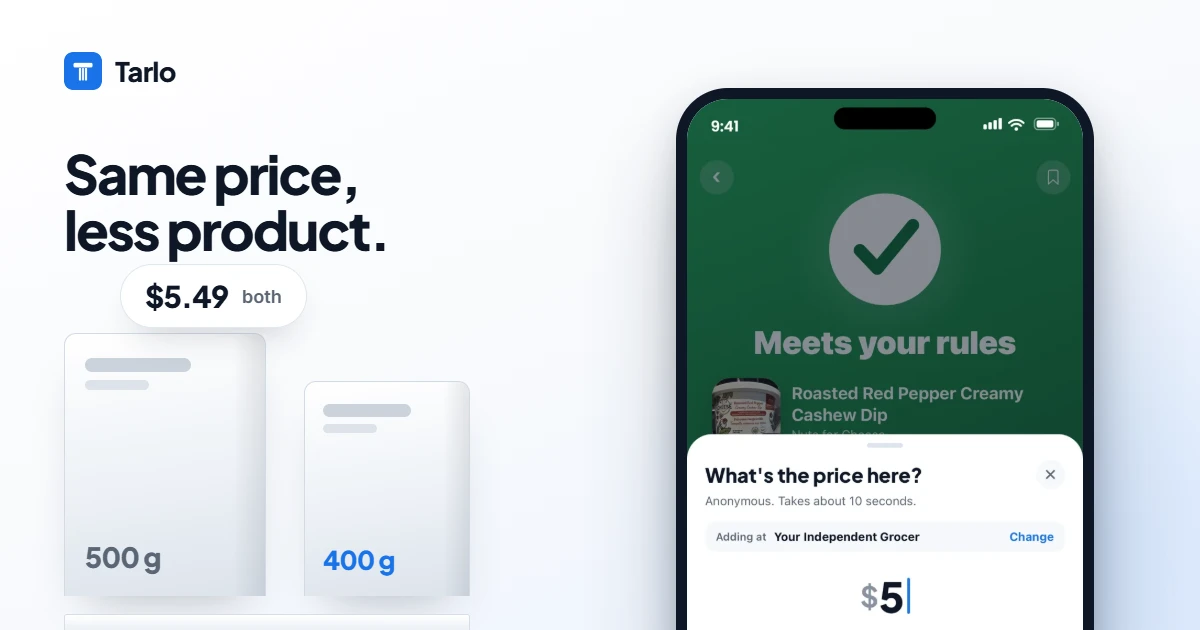
Shrinkflation is inflation’s quiet sibling: the price stays put while the package loses 30 grams, and unless you memorized the old net weight, you’ll never notice at the shelf. Canadians have watched it across cereal boxes, chip bags, “1 L” juices that became 890 mL, and paper products for years. Here’s how the mechanics work, the two honest defences a shopper has, and where scanning fits.
The relevant Tarlo bit: shopper-reported prices attach to a specific barcode — and a shrink means a new barcode’s price history, which is exactly the paper trail shrinkflation tries not to leave. More below.
How shrinkflation works
The economics are simple and, from the manufacturer’s chair, rational: input costs rise; raising the sticker price is visible and punished by shoppers instantly; shrinking the net weight is nearly invisible — same box footprint, same shelf price, 8% less inside. Research consistently shows shoppers track prices far better than quantities. It’s legal everywhere (the net weight is declared, as required), and it’s a global practice with a particularly good paper trail in Canada thanks to years of grocery-price scrutiny, parliamentary hearings and media coverage.
The tells at package level: “new look!” redesigns that coincide with weight changes, taller-but-thinner bottles, deeper jar dimples, more air in the bag, and family sizes that quietly aren’t.
The patterns to watch
Where Canadian shoppers have documented it most: cereal (boxes holding 5–10% less across waves), chips and snacks (the bag stays, the grams go), juice and beverages (1 L → 946 mL → 890 mL is a famous staircase), coffee (the “pound” that became 340 g), paper products (sheet counts and sheet sizes), and chocolate bars (grams shaved at each redesign). None of this is secret — the net weight is printed — it just relies on nobody reading it twice, months apart.
Defence 1: the unit price
The classic defence: ignore the package price, read the unit price — dollars per 100 g/mL — on the shelf tag. Unit price is shrink-proof by construction: when contents drop and price holds, $/100 g rises and says so. Two Canadian frictions: unit-price display isn’t uniformly mandated nationally (Quebec regulates it most tightly; elsewhere practice varies by chain), and when displayed it’s often tiny, inconsistent in units ($/100 g here, $/kg there), and occasionally wrong. It’s still the single best habit in the store — and doing the division yourself (price ÷ net weight × 100) takes five seconds when the tag won’t.
Defence 2: the barcode trail
Here’s the quieter defence: a resized product usually gets a new barcode (a new size is a new SKU). That has two consequences. First, your memory of “this was $4.99” often survives the shrink because the price didn’t change — but a scan-history does better: Tarlo’s shopper-reported prices attach to specific barcodes with dates, so the old SKU’s price story stays on record while the new SKU starts its own, and per-unit context makes the comparison honest. Second, catalog data carries net quantity — which means over time, the crowd’s scans build exactly the longitudinal record (same product family, shrinking grams) that shrinkflation counts on nobody keeping. That record grows with every scan; it’s one of the quiet reasons the community model matters.
The cousin: skimpflation
The harder-to-see sibling: same size, same price, cheaper recipe — a little less olive oil in the blend, a switch to and/or seed oils, more maltodextrin filler, glucose-fructose replacing sugar. No weight change, no unit-price signal — only the ingredient list shifts. This is where rules-based scanning genuinely outperforms shelf vigilance: your rules re-check the recipe on every scan, so a reformulation that newly trips a rule surfaces immediately, the same mechanism that catches FOP-dodging reformulations.
Frequently asked questions
Is shrinkflation illegal or deceptive under Canadian law?
Legal, as long as the net quantity is accurately declared. The Competition Bureau has studied grocery pricing broadly, and France-style mandatory shrink-disclosure has been discussed in Canada — but today the printed net weight is the whole disclosure.
Does the front-of-package symbol change with shrinkflation?
No — the FOP thresholds are computed per standardized reference amount, not per package, so shrinking a box doesn’t dodge a symbol. One yardstick the practice can’t move.
What’s the fastest in-store check?
Shelf-tag unit price, or price ÷ grams on your phone. Between two sizes of the same product, the bigger unit isn’t always cheaper per 100 g — promos scramble it, which is why the arithmetic beats the assumption.
Can Tarlo alert me when a product shrinks?
Today it gives you the ingredients, the per-unit context and the barcode-anchored price history that make shrinks visible. Automatic shrink alerts are a natural future step as the crowd’s data deepens — the record being built now is what makes that possible.
Sources
- Statistics Canada — food price indices and CPI methodology: statcan.gc.ca
- Competition Bureau Canada — retail grocery market study.
- Office de la protection du consommateur (Québec) — unit-price display rules.
Tarlo reflects the rules you turn on and is for general information only — it is not medical or dietary advice. Regulatory details are Canadian and current as of the date above; always verify the product's physical label.